PART 2 OF 3 — BARN PLANNING 101
Horse Stall Design & Safety: What Actually Matters
If Part 1 was about planning your barn layout, Part 2 is where the details start to carry real weight.
Stall design directly impacts horse safety, daily operational efficiency, and long-term durability. It is also where the most expensive mistakes are made — not because owners do not care, but because the decisions look simple until something goes wrong.
This article walks through each element of stall design with specifics: the numbers that matter, the trade-offs worth understanding, and the mistakes we see most often on real projects.
1. Stall Size: More Than a Square on a Floor Plan
Most stalls fall within a fairly consistent range:
- 10’ x 10’ — minimum threshold, suitable for smaller breeds and ponies
- 12’ x 12’ — the recognized standard for an average riding horse
- 12’ x 14’ or larger — recommended for horses exceeding 17 hands
- 16’ x 20’ or more — the appropriate range for foaling stalls – keep in mind a horse that is well cared for will stay in any size stall, but keep in mind the ideas below.
What that list does not tell you is that stall size should be determined by how the horse actually lives — not just its measurements.
A horse that is stalled 20 hours a day has fundamentally different space requirements than one that is in a stall only overnight. Temperament matters too. A horse that paces under stress, or one that requires room to move to manage a physical condition, may need a larger footprint than its breed would suggest.
The most serious risk with undersized stalls is casting — a horse lying down too close to a wall and being unable to get up because its legs have no room to push off. This is more common in 10’ x 10’ configurations with larger horses, and it is a genuine welfare and safety risk. A horse that cannot rise is at risk of injury, panic, and exhaustion.
Practical rule: size for the horse’s life, not just its body.
2. Partition Height: A Safety Requirement, Not a Style Choice
Industry guidance is consistent: partition height should be a minimum of 7.5 feet, with 8 feet recognized as the standard. The reason is specific — most horses can kick as high as 7 feet, and the partition needs enough clearance above that to prevent legs from clearing the wall during kicks or moments of stress or play.
Overhead clearance inside the barn also matters. A ceiling lower than 10 feet restricts airflow and increases the risk of a horse striking its head if it rears. The recommended interior ceiling height is 10 to 12 feet, with open-rafter or open-truss construction being the best option when it can be accommodated.
Partition height decisions also interact with grill spacing. Any open sections below 48 inches should have bar spacing of no more than 1 inch to prevent hoof entrapment. Above that height, grill openings are typically limited to 2 to 3 inches — enough for airflow and visibility, not enough for a hoof or leg to become trapped.
Where owners sometimes get this wrong: older barn retrofits with lower existing ceiling heights. A 7’6” partition may be the maximum the structure allows — which is technically within the minimum standard — but it is not something to accept without awareness of the trade-off involved.
3. Partition Design: Solid vs. Open vs. Combined
This is where the real decision-making happens, and where a single answer does not serve every situation.
Solid partitions from floor to ceiling provide the strongest visual and physical separation. They are appropriate for horses that are aggressive toward neighbours, for isolation stalls, or in some breeding and veterinary facility applications. The significant trade-off is airflow. Fully solid partitions create stagnant air inside the stall even when the aisle is well ventilated. If solid sidewalls are required for a specific horse, the front wall becomes critical — grillwork or mesh on the stall front becomes the primary ventilation path.
Open grill or mesh designs throughout allow maximum airflow and allow horses to see stablemates and barn activity. Research supports this from a behavioural standpoint: horses in more open environments show lower rates of stall vices and stress-related behaviour because social visibility reduces isolation. The trade-off is that open designs can increase aggression risk between incompatible horses.
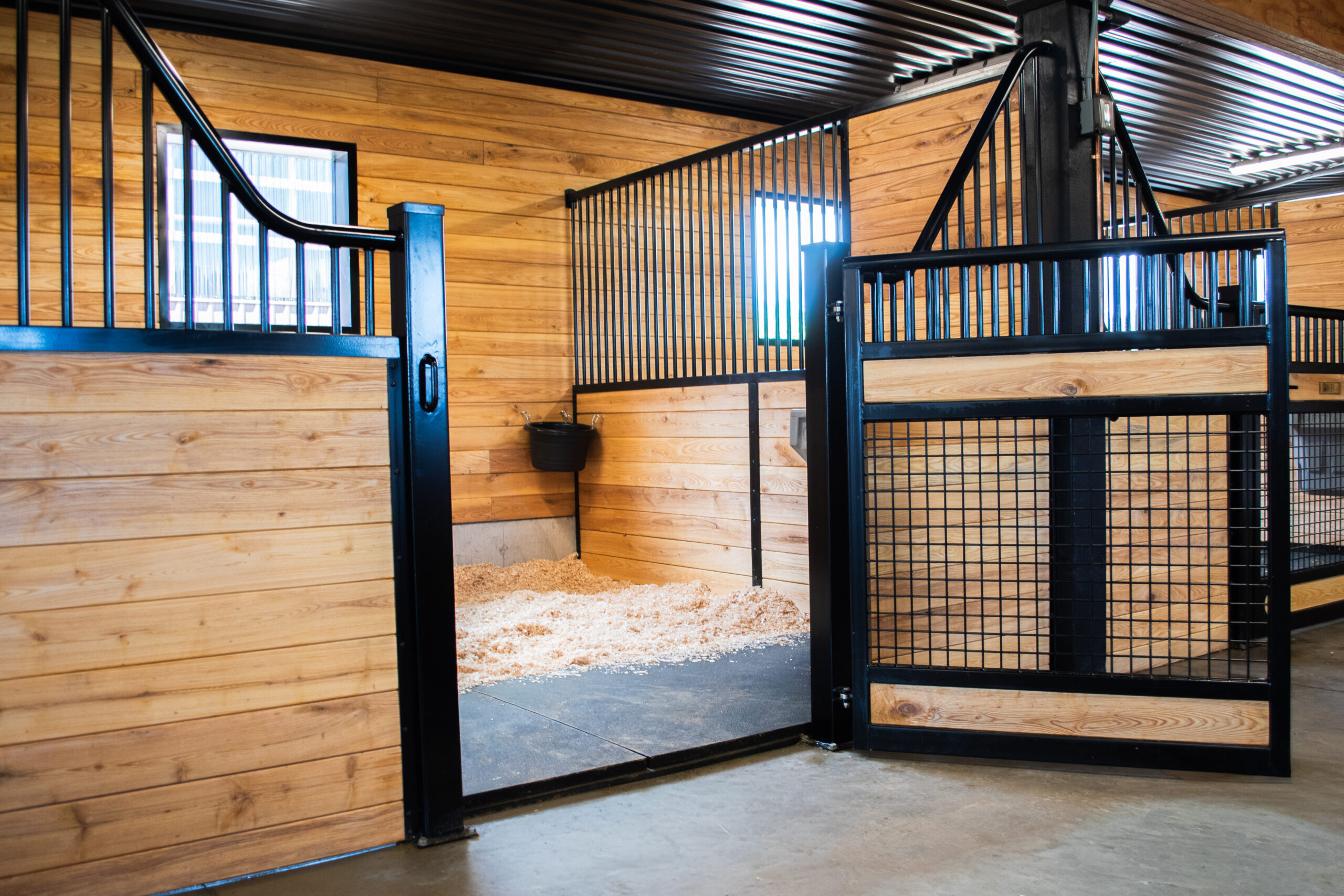
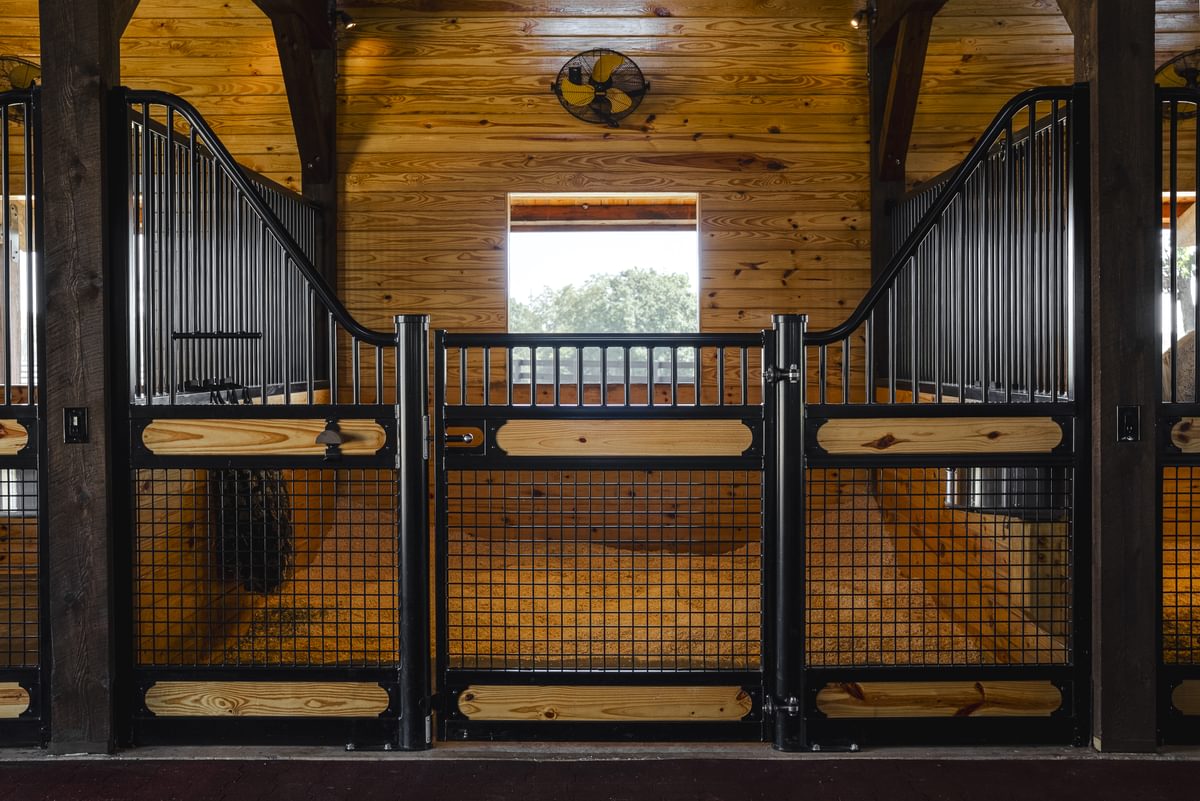
The most practical design for most barns combines a solid lower section — typically 48 to 60 inches — with open grillwork or mesh above. This manages kicking injury risk at the lower level while maintaining airflow and social connection at the upper level. It is the design we recommend most consistently, and it is the configuration supported by most equine facility planning references.
A note on materials: grill bars in open sections should be vertical rather than horizontal, and spaced no more than 2 to 3 inches apart. Horizontal bars create a climbing foothold. Improperly spaced vertical bars create entrapment risk. These are small details that have meaningful safety consequences.
4. Stall Doors: Where Daily Friction Becomes a Real Problem
Stall door failures rarely look dramatic. They show up as doors that are slightly harder to open after a year, latches that need an extra push to engage, tracks that collect debris and drag. Over time, these small inefficiencies add up to handler frustration, workarounds, and eventually safety risk.
The functional standards worth holding to:
- Door opening width: minimum 42 to 45 inches, with 4 to 4.5 feet preferred for safe horse-and-handler movement
- Door headroom: minimum 7 feet, with 8 feet recommended if the structure allows
- Sliding doors strongly preferred over swinging doors — swinging doors create collision risk in the aisle and handling problems when the horse is near the entrance
- Single-hand operation so the handler is never forced to use both hands while managing a horse
What actually matters in a sliding door system: smooth operation under daily use, quiet movement (which reduces horse stress during entry and exit), and a bottom track that does not accumulate bedding or debris. Systems with sealed or minimally exposed track configurations hold up significantly better over years of use than open-channel designs.
What we see go wrong: doors that work fine at install and become a problem within months. That is a specification issue, not a maintenance issue.
5. Hardware and Latches: The Most Underrated Safety Risk in the Barn
Hardware failure is responsible for a significant portion of stall-related incidents. A horse that learns to open a latch — and many do — is at risk of escaping into aisles, adjacent paddocks, or worse. Escaped horses create immediate safety risk for themselves, other animals, and people on the property.
The functional requirements for stall latches are specific:
- Horse-proof — many standard bolt-type latches can be worked open by a horse with enough time and motivation; purpose-designed equine latches requiring two-step operation are significantly more secure, horseshoe latch with a catch.
- Quick-release for a human handler — in an emergency, a latch that requires tools or significant effort is a liability; single-motion or one-hand release is the baseline to meet
- Durable under repeated daily use — low-quality hardware corrodes, fatigues, and fails
Interior hardware and fixtures throughout the stall should be smooth, recessed, or specifically designed to eliminate projections. A horse moving quickly in a stall can contact a wall-mounted bucket bracket, hay rack mounting, or improperly installed fixture and suffer a serious laceration. Every interior surface and fixture should be evaluated with this in mind.
This is not a place to value-engineer the budget down.
6. Ventilation at the Stall Level — Not Just the Barn
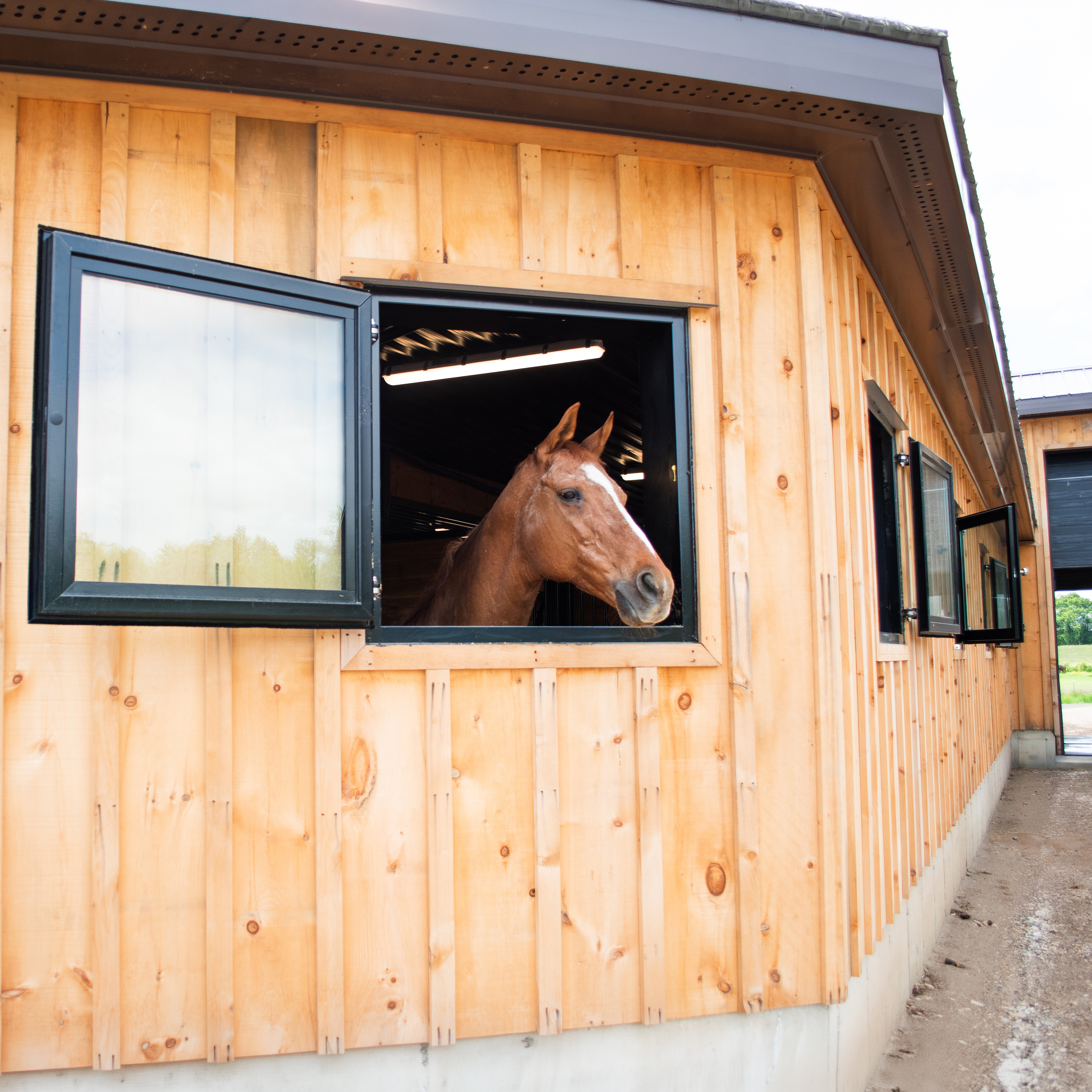
This is one of the most commonly misunderstood elements of stall design. A barn can be well-ventilated at the ridge and along the aisles while the individual stalls suffer from poor air quality. The two systems are connected but not the same.
The health consequences of poor stall-level ventilation are well documented. Ammonia from urine accumulates at floor level — which is exactly where a lying horse’s face is positioned during rest. Dust and mould spores from bedding contribute to inflammatory airway disease. Veterinary research documents a clear increase in equine respiratory conditions in stalled horses with inadequate ventilation, including what is increasingly referred to as equine asthma.
If you can smell ammonia when you enter the barn, the ventilation is not adequate.
The design solutions:
- Open grillwork on the upper section of stall partitions and stall fronts allows air to move through the stall rather than sitting stagnant while the aisle ventilates freely — this is the single most impactful design decision for stall-level air quality
- Mechanical ventilation rates, when fans are part of the system, should target approximately 25 CFM per 1,000 pounds of horse in cold weather, 100 CFM in mild weather, and 200 to 350 CFM in hot conditions
- No ceiling — or a ceiling positioned at a minimum of 12 feet — allows heat and moisture to rise and exhaust through ridge vents rather than recirculating through the stall zone
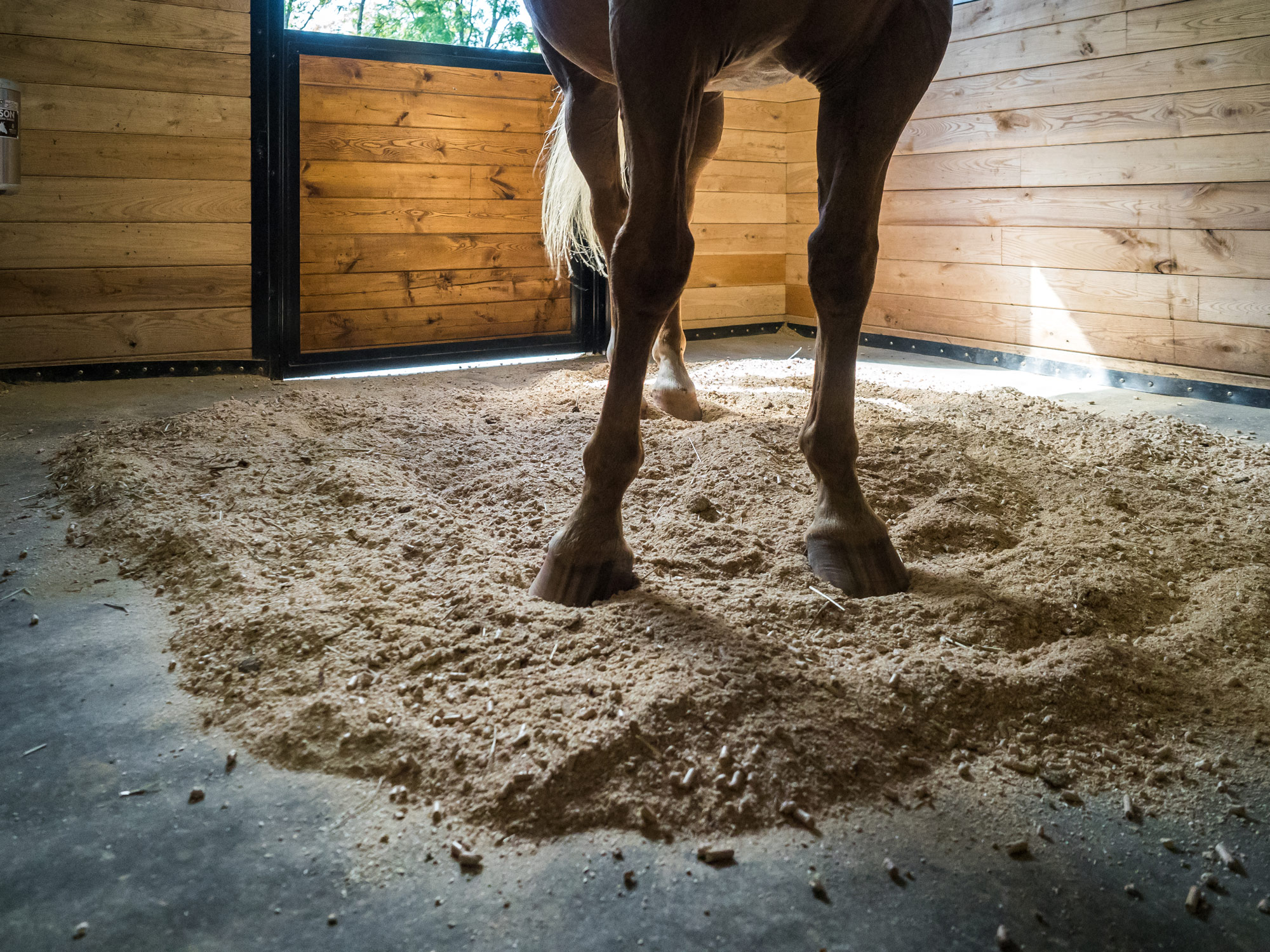
- Bedding choice matters: dust-free or reduced-dust shavings are preferable to standard shavings for respiratory health; the underlying floor system needs to support drainage so urine does not pool beneath the bedding layer
7. Flooring: The Foundation of Horse Welfare
Stall flooring is often treated as a finishing decision. It is not. Flooring affects joint health, respiratory health, traction, rest quality, and long-term soundness — all of which have direct implications for horse welfare and, in a professional operation, veterinary costs.
The most effective approach is a layered system:
- 4 to 6 inches of compacted crushed stone as a drainage base
- A layer of sand or stone dust over the stone base
- Commercial rubber stall mats for a resilient, non-slip, cleanable surface
- Appropriate bedding on top to manage moisture and provide comfort
Rubber mats are the most consistently recommended component by equine facility professionals. They reduce the amount of bedding required — which reduces ongoing cost — while providing cushioning for joints and a surface that does not absorb ammonia the way bare concrete or compressed earth does. They also allow thorough cleaning between horses, which matters for biosecurity in any boarding or training operation.
Bare concrete without mats should be avoided. It is hard, slippery when wet, offers no cushioning for a horse’s joints during the hours spent standing, and retains odour at a level that cannot be adequately addressed through cleaning alone.
Stable Comfort matting is another upgrade that provides a cushioned surface.
Drainage from the stall should be considered at the design stage, not as an afterthought. Improperly sloped floors that allow urine to pool under bedding create exactly the ammonia conditions that compromise respiratory health.
8. Aisle Width: A Hidden Safety Factor
Aisle design is frequently compressed in the planning stage to add stall space or reduce building footprint. This is a trade-off worth understanding clearly before the decision is made.
- 10 feet — workable minimum for horse movement and handler safety
- 12 feet — allows safe cross-tying; the more widely recommended figure for most operations
- 14 to 16 feet — required if equipment or tack storage is positioned along the aisle wall
Narrow aisles create daily friction: harder to manoeuvre horses, reduced space for emergency access, and restricted equipment movement for cleaning. In a busy operation, an aisle that is even marginally undersized becomes a compounding inefficiency over months and years.
9. Materials and Durability: What Holds Up Under Real Conditions
Material choices in a stall system look different at installation than they do after five years of daily use. The evaluation framework should account for:
Moisture resistance. Stalls are wet environments. Wood that is not properly selected, treated, or protected will degrade. Steel that is not properly coated will corrode. G90 pre-galvanized steel provides a strong baseline for structural components. Powder coating at an automotive-grade standard adds meaningful durability over standard paint or basic coatings.
Impact resistance. Horses kick. A horse kicking a lower partition panel delivers significant force repeatedly over years of use. Materials that are visually appealing but not impact-resistant fail in ways that are expensive to repair and potentially unsafe when they do.
Cleanability. Surfaces that are difficult to clean thoroughly create biosecurity risk in any shared facility and ongoing odour management problems in any stall environment.
Longevity. Stall systems that require significant repair or replacement within ten years were not properly specified at the outset. The cost difference between a well-specified and a poorly specified system is almost always smaller than the long-term cost of maintenance, repair, and replacement.
Wood remains a practical and widely used option for partition infill, particularly tongue-and-groove Ash or composite. Steel framing with wood or HDPE infill represents a strong combination for most professional applications. Whatever the material choice, horizontal wood edges should be capped with metal to prevent cribbing damage.
10. The Difference Between Design and Assembly
This distinction matters more than almost anything else in this article.
Installation of a stall system is a technical task. Design of a stall system is a professional one. Anyone with the right equipment and materials can install stalls that look correct on day one. Far fewer can design a system that accounts for the interaction between horse behaviour, airflow patterns, daily operational workflow, material durability, and long-term wear — simultaneously.
A well-designed stall system considers how air moves through the space when the doors are open and when they are closed. It considers how handlers move through the aisle during feeding, cleaning, and emergency response. It considers what happens to material connections and hardware after seven years of daily use in a humid, high-traffic environment. It considers the specific horses that will live in the space, not just average industry dimensions.
These are not small details. They are the difference between a barn that functions well for twenty years and one that generates problems within the first five.
Common Stall Design Mistakes — What We See on Real Projects
- Undersized stalls built around floor plan efficiency rather than horse welfare
- Poor airflow at the stall level despite a well-ventilated barn structure — the aisle ventilates and the stalls stagnate
- Cheap or inadequate hardware specified to reduce project cost
- Inefficient door placement that creates handling problems or aisle congestion during daily operations
- Flooring specified for cost rather than performance — bare concrete, improperly sloped subfloors, and mats installed over surfaces that cannot drain adequately
- Materials chosen for appearance rather than real-world durability
Most of these are avoidable with proper planning. Almost all of them are significantly more expensive to correct after construction than to get right at the design stage.
Final Thought: This Is Where Quality Actually Shows
At first glance, many stall systems look comparable. The differences emerge over time — in horse health, handler efficiency, maintenance requirements, and the cost of repairs that proper specification would have prevented.
A great barn is not a collection of well-selected individual components. It is a system designed to function as a whole, under the real conditions of daily equine operation, for decades. That level of design requires experience, attention to detail, and a genuine understanding of how horses live and how people work.
This is where the difference between stalls that look good and stalls that work shows up. It is worth getting right the first time.
Up Next: Part 3 — Fencing and Turnout Systems
In Part 3, we’ll look at how to design safe, durable turnout areas that work with your barn rather than against it — fencing materials, gate placement, perimeter planning, and the operational decisions that determine whether your turnout system is functional for years or a source of ongoing maintenance.
Planning stalls and want a second set of eyes?
We are happy to walk through your layout and specific requirements — no pressure, just practical input from real-world projects.
System Equine — Your Equine Solutions Partner
Don’t forget to follow us on social media to see more of our work!