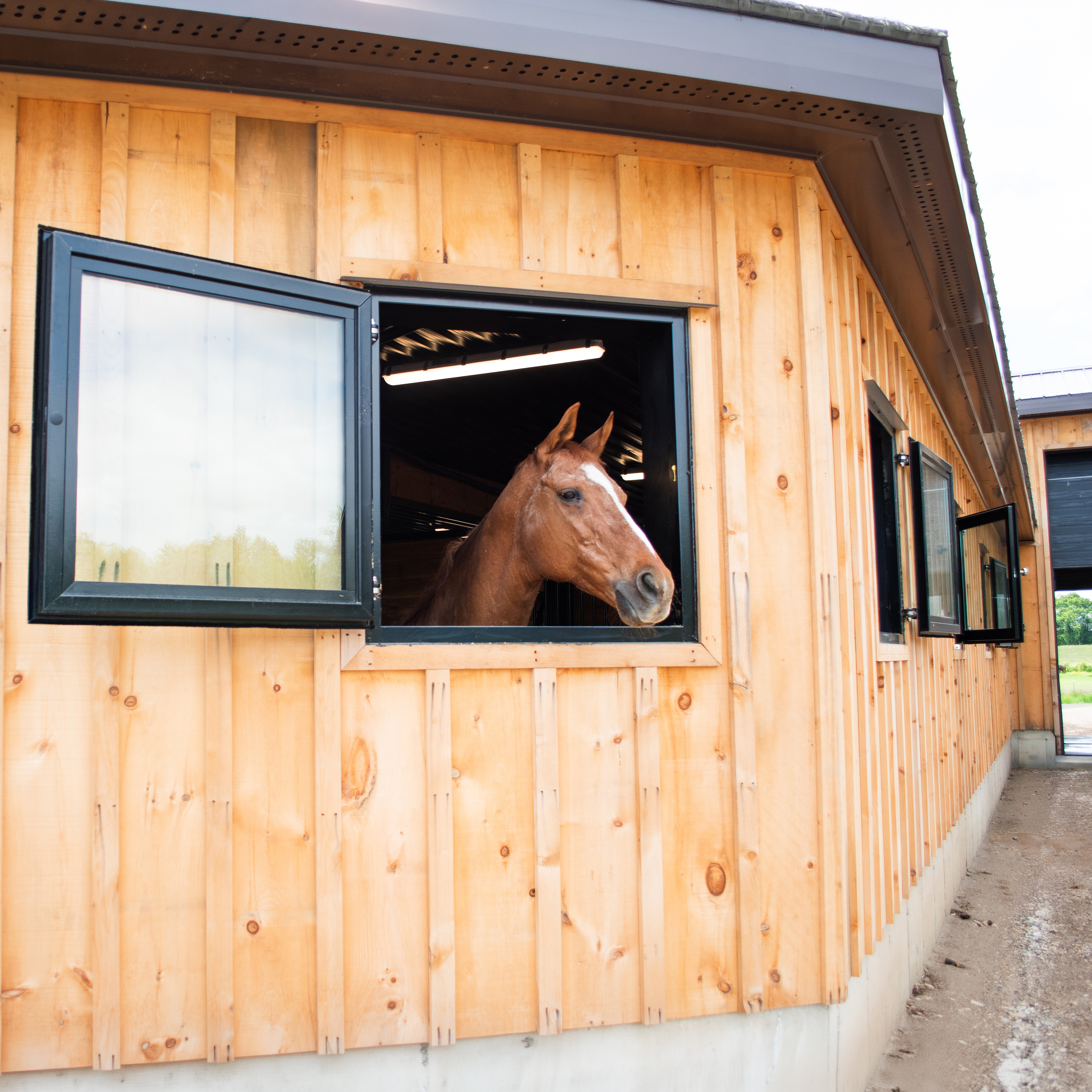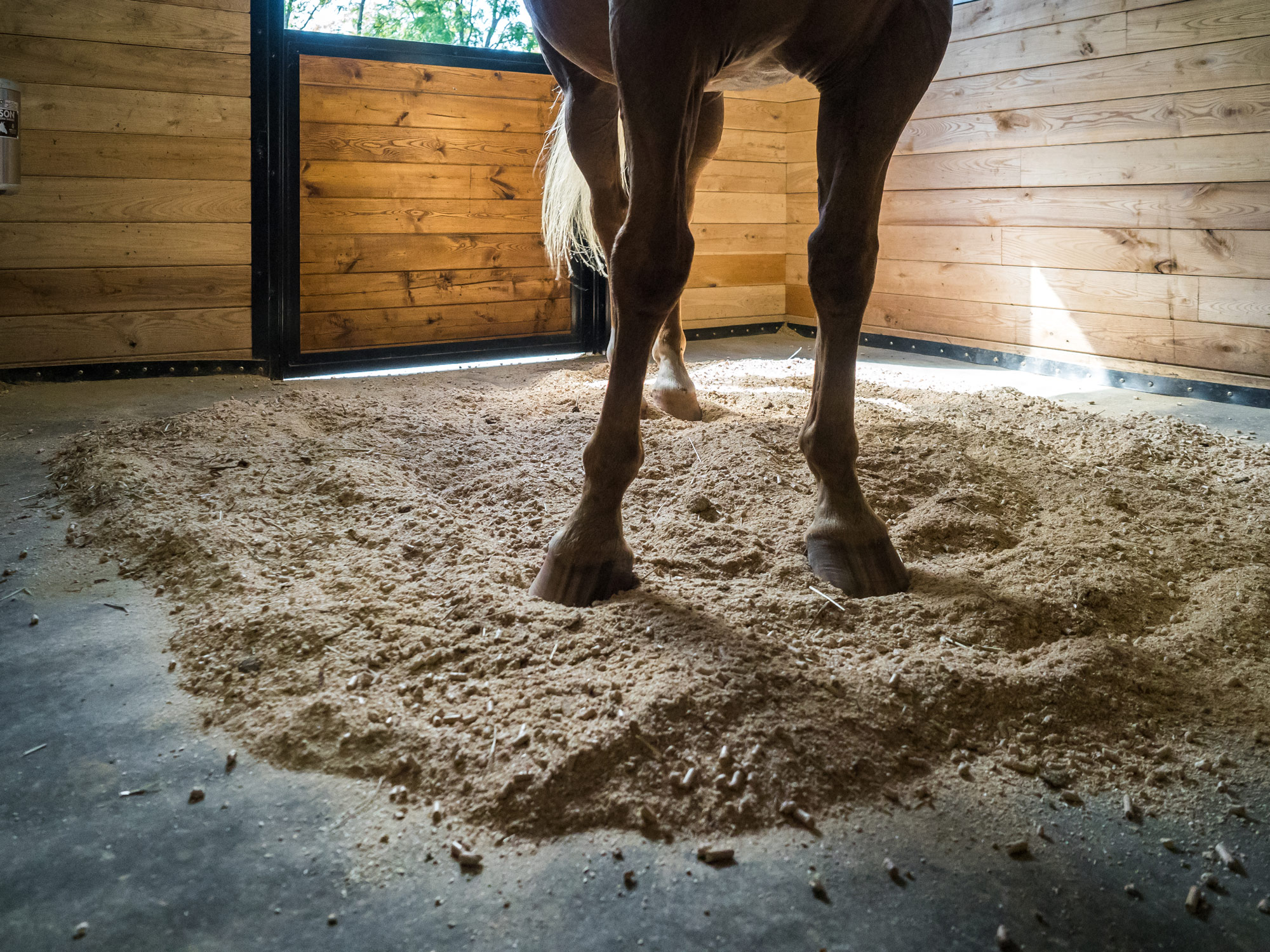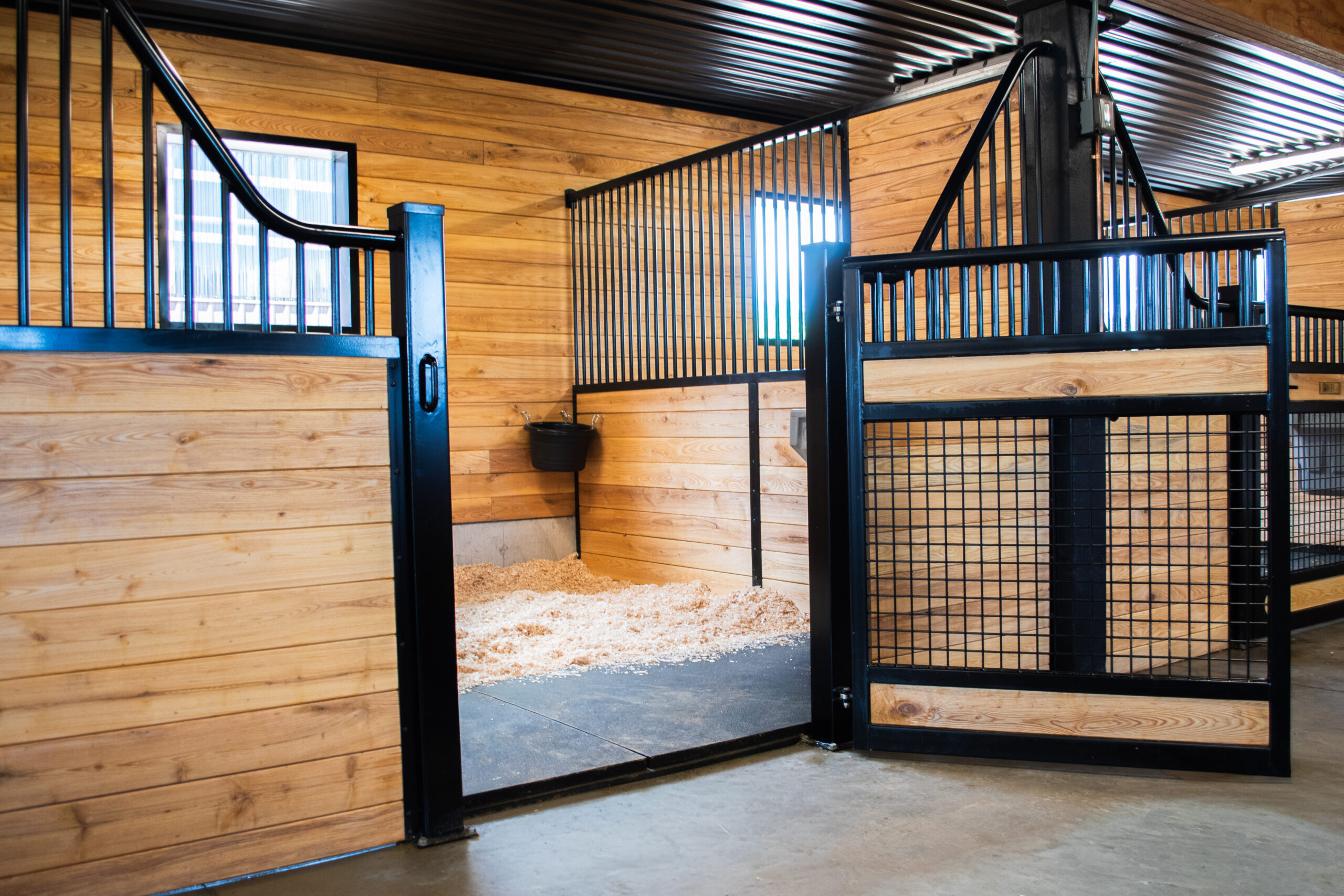

A horse stall is more than just a space, it’s the cornerstone of a safe, efficient, and welcoming barn.
The right design protects your horses, supports their well-being, and streamlines daily care. It also speaks volumes about the pride and professionalism behind your stable. Whether you’re a private owner or managing a commercial operation, stall design should strike the perfect balance between durability, function, and aesthetics. After all, while a horse might be content in any safe, roomy space, the look and feel of your barn leaves a lasting impression on every visitor, and potential buyer.
📑 Table of Contents: The Complete Guide to Buying Horse Stalls
1. Introduction
- Why stalls matter: safety, welfare, efficiency, aesthetics
- Overview of stall cost ranges (Canada vs. U.S.)
- The Good / Better / Best framework
2. Stall Types & Styles
- Sliding-door fronts (value, space-saving)
- Hinged/Euro-style fronts (premium aesthetics, ventilation)
- Kit stalls vs. fully welded fronts
- Custom vs. standard sizes
3. Materials & Finishes
- Steel (galvanized, pre-galv + powder coat, hot-dip galvanized, stainless steel)
- Powder coat finishes (pros/cons, color matching)
- Lumber options (pine, ash, HDPE/eco-board)
- Hardware: latches, hinges, rollers, chew guards
4. Stall Components & Features
- Fronts (sliding vs. hinged)
- Partitions (grilled vs. solid)
- Feed doors, hay doors, bucket doors
- Yokes & horse head openings
- Windows & Dutch doors (stall-to-paddock connections)
- Accessories (blanket bars, bridle hooks, feeders, automatic waterers)
5. Flooring & Mats
- Interlocking mats vs. mattress systems
- Bedding management (costs, comfort, sanitation)
- Regional considerations (frost heave, concrete base vs. packed screenings)
6. Climate & Regional Factors
- Canada: snow load, condensation, galvanizing importance
- U.S. South: heat, ventilation, powder coat appeal
- Coastal barns: salt air corrosion prevention
- Insulation, ventilation, and natural light considerations
7. Safety & Welfare Considerations
- Bar spacing & kick protection
- Airflow & dust management
- Noise, chew, and stress reduction
- Visibility for horses (grilled partitions vs. solid walls)
8. Cost Drivers
- Stall front type (sliding vs. Euro)
- Finish choice (galv vs. powder coat vs. stainless)
- Lumber inclusion (many kits exclude wood)
- Accessories and upgrades
- Freight & delivery (LTL, rural surcharges, cross-border shipping)
- Installation costs (DIY vs. professional install)
9. The Good / Better / Best Model (System Equine)
- Good: Standard Stall Kits (value option)
- Better: Freedom Stall Series (flexible, customizable)
- Best: Des Coteaux Euro-style Stalls (premium showcase option)
- Where each fits: private barns, boarding barns, show facilities
10. Competitor Benchmarking (Canada & U.S.)
- Canada: Miracle Ranch Equipment, Livestock Equipment Canada, System Equine
- U.S.: Priefert, WW, RAMM, Blackwood, System Equine (U.S.)
- Published pricing comparisons
11. Freight, Duties & Tariffs
- Canadian tariffs on imported steel & aluminum
- Cross-border shipping realities (CAD vs. USD pricing)
- LTL delivery best practices
12. Installation Options
- DIY installation (skills, time, tools required)
- Professional installation (System Equine services, local installers)
- Site preparation: concrete, posts, flooring, anchors
- Typical timelines for install
13. All-In Budgeting Examples (will need to work on this)
- Cost per stall (front + partition + lumber + finish + accessories + freight + install)
- Small private barn (2–4 stalls)
- Boarding barn (6–12 stalls)
- Showcase barn (12+ stalls, premium options)
14. ROI & Long-Term Value
- Horse welfare & reduced vet costs
- Time savings (sliding doors, integrated features)
- Resale value of property with quality stalls
15. Procurement Checklist
- Define your barn’s purpose (private, boarding, training, show)
- Decide on Good / Better / Best tier
- Select finish for climate
- Choose lumber / infill type
- Accessories to include now vs. later
- Freight & install plan
- Confirm warranty & service support
16. Conclusion & Next Steps
- Why investing in the right stall system pays off
- Links to request a System Equine quote (Canada & U.S.)
- Downloadable budget worksheet (optional gated content)
Why Stalls Matter: Safety, Welfare, Efficiency, Aesthetics
Horse stalls are more than just four walls and a door, they are the foundation of a safe, efficient, and welcoming barn. A well-designed stall protects horses from injury, promotes their physical and mental well-being, and simplifies daily routines for caretakers. At the same time, stalls contribute to the overall look and feel of a stable, reflecting the pride and professionalism of the facility.
Whether for private horse owners or large commercial operations, the right stall design balances durability, functionality, and beauty. If you are selling horses perception is everything, and a stable to looks amazing so must be the horses. We need to remember a horse will be happy in an old chicken coup as long as there is enough room to move around and the head height is okay.
Overview of Stall Cost Ranges (Canada vs. U.S.)
Cost is often one of the first questions people ask when planning a barn. In North America, pricing can vary widely depending on materials, features, and local market conditions. In North America, the cost of a standard stall front might range anywhere from $1,000 to $6,000 per stall, However, premium custom options—such as powder-coated finishes, integrated feeders, or decorative European fronts—can easily exceed $6,000 per stall on either side of the border. Understanding where your project falls within this spectrum helps set realistic expectations early on.
The Good / Better / Best Framework
To simplify decision-making, it’s useful to think about stalls within a Good / Better / Best framework:
- Good: Functional, safe stalls built with standard galvanized steel and straightforward designs. Reliable and budget-friendly, but minimal in aesthetic upgrades. (link to Standard Stalls
- Better: Enhanced designs that include powder coating, additional airflow features, or moderate customization for a more polished look and improved horse comfort.
- Best: Fully customized, high-end stalls featuring premium finishes, integrated hardware, advanced ventilation, and design elements tailored to the barn’s architecture. These stalls are as much a design statement as they are a functional necessity.
This framework provides a clear roadmap for owners and builders—whether prioritizing affordability, durability, or showpiece quality.

Stall Types & Styles
Sliding-Door Fronts (Value & Space-Saving)
Sliding doors are practical and efficient, especially in barns where aisle space is limited. Because the doors glide rather than swing, they keep traffic flowing and minimize the risk of doors interfering with horses or handlers. They are durable and affordable, making them the “value” option while still delivering safe, professional results.
Hinged/Euro-Style Fronts (Premium Aesthetics & Ventilation)
European-inspired hinged doors deliver a striking first impression. With arched tops, yokes, or open panels, they allow more air circulation and encourage horse socialization. These stalls are often chosen for showpiece barns where both form and function matter. The trade-off is that hinged doors require more aisle clearance and carry a higher cost.
Kit Stalls vs. Fully Welded Fronts
- Kit stalls are shipped in components—posts, channels, and doors—making them flexible and cost-effective, particularly if integrating into an existing wood post barn. They’re ideal for DIY or contractor installs.
- Fully welded fronts are delivered as solid panels, offering maximum strength, rigidity, and speed of installation. They are best suited for projects with new curb-and-post systems or high-end builds where aesthetics and longevity are priorities.
Custom vs. Standard Sizes
Standard 10’x10’ or 12’x12’ stalls remain the most cost-efficient and readily available. Custom designs, however, can accommodate drafts, minis, or unique barn footprints. Customization also allows for design continuity with architectural plans, making them the choice for owners seeking a tailored look.
Integration with Builders & Architects
Whether your barn is being built around existing wood posts, a wide-open clear-span area, or a new curb-and-post system, we can provide or develop a stall solution that fits seamlessly with your construction approach. For design professionals, we also provide CAD versions of our stall systems, allowing architects and builders to integrate stalls directly into their drawing packages—streamlining the design and planning process.
Comparison Tables
Sliding vs. Hinged Fronts
| Feature | Sliding Door Fronts | Hinged / Euro-Style Fronts |
| Cost | Lower (Value) | Higher (Premium) |
| Space Use | No aisle clearance needed | Requires aisle clearance |
| Aesthetics | Functional, clean | Elegant, statement piece |
| Ventilation | Moderate | Excellent (openings, yokes) |
| Best For | Busy barns, smaller aisles | High-end barns, design-driven builds |
Kit vs. Fully Welded Fronts
| Feature | Kit Stalls | Fully Welded Fronts |
| Cost | Lower upfront | Higher upfront |
| Installation | Requires assembly | Quick installation |
| Strength | Strong, but screwed together | Maximum strength, seamless |
| Flexibility | Works with existing structures | Best with new construction |
| Best For | DIY, retrofits, wood post barns | Premium barns, curb/post systems |
Standard vs. Custom Sizes
| Feature | Standard Sizes (10’x10’, 12’x12’) | Custom Sizes |
| Cost | Most economical | Higher (design + build time) |
| Availability | Fast turnaround | Made to order |
| Fit | Ideal for average horses | Drafts, minis, or unique barn layouts |
| Design Options | Limited | Unlimited (finishes, dimensions) |
| Best For | General barns | Tailored, architectural builds |
Materials & Finishes
Steel Options
The foundation of any stall system lies in its steel. Different finishes provide varying levels of durability, corrosion resistance, and aesthetics:
- Galvanized Steel: Cost-effective, rust-resistant, and long-lasting. A popular choice for standard barns.
- Pre-Galvanized + Powder Coat: Combines the protective zinc layer of galvanization with a durable, colored finish. This creates a sleek look while adding another barrier against rust.
- Hot-Dip Galvanized: Steel is submerged in molten zinc, creating an exceptionally thick coating. Ideal for barns exposed to moisture, humidity or corrosive environments.
- Stainless Steel: Premium option, offering unmatched resistance to rust. However, not all stainless is equal — 304 stainless is insufficient in coastal or Florida environments due to salt corrosion. In these cases, a higher grade such as 316 stainless is required for longevity.
Powder Coat Finishes & Surface Prep
Powder coating offers a wide range of colors and a smooth, durable surface finish — but its success depends heavily on how well the steel is prepared beforehand. A professional process typically involves:
- Shot blasting — The steel is blasted with abrasive media (e.g., steel shot) to remove any surface imperfections, weld scale, rust, mill scale, or old coatings. This creates a fresh, clean substrate with a slight rough profile for coating adhesion.
- Multi-stage wash / pretreatment — After blasting, steel passes through a multi-stage cleaning and chemical pretreatment process (for example, a 7-stage or 8-stage wash system) that removes oils, salts, surface contaminants, and provides a conversion coating to assist adhesion and corrosion resistance
- Pre-heat / bake / curing — Once cleaned and coated, steel may be pre-heated and then the powder applied, followed by a cure cycle that bonds the coating and builds its hardness and durability.
- Quality inspection — Visual inspection, adhesion testing and sometimes thickness checks ensure the finish meets architectural/industrial standards (for example, compliance with AAMA- or ASTM-type specifications).
Why this matters: Without proper surface prep, coatings may peel, flake, or fail prematurely — even the best powder finish will under-perform if the steel under it is poorly prepared. As one powder-coating facility puts it: “Surface preparation is essential for achieving a durable and aesthetically pleasing finish.”
Tip: If you’re specifying powder-coated steel front systems for stalls, make sure your contract or spec sheet calls out: shot-blasted substrate, multi-stage wash/pretreatment, pre-heat and a recognized coating standard (e.g., AAMA 2604/2605 for architectural powder coatings).
Powder Coat Finishes (Pros / Cons)
Pros:
- Enhances your barn’s appearance with customizable colors that can match trim, branding or architectural details.
- Adds a durable barrier of protection against rust and corrosion.
- More chip-resistant and long-lasting than standard paint.
Cons:
- Higher cost than plain galvanized steel.
- If struck hard or if the substrate preparation is inadequate, the coating may still chip or fail.
- Requires quality finishing facility and proper process — not all facilities are equal.
Lumber Options
Wood or wood-alternative infill materials play a big role in stall appearance and longevity:
- Southern Yellow Pine: Affordable and strong, but softer and more prone to chewing.
- Spruce: Lightweight and economical, though less durable.
- White Oak: Dense and highly durable, making it one of the best traditional stall woods.
- Ash: Strong and attractive, often chosen for its lighter color and smooth grain.
- HDPE / Eco-Board: Recycled plastic lumber that is chew-resistant, low maintenance and environmentally friendly.
- Recycled Plastic Board: Similar to HDPE, excellent for durability and rot resistance.
- Bamboo: Sustainable, renewable and gaining traction as an eco-conscious choice.
Hardware & Accessories
The details make the difference. High-quality hardware ensures stalls are functional, safe and long-lasting:
- Latches: Options range from simple slide bolts to premium lockable systems for added security.
- Hinges: Heavy-duty adjustable hinges prevent sagging and extend the stall’s life.
- Rollers: For sliding doors, smooth, sealed-bearing rollers ensure effortless operation.
- Chew Guards: Protect exposed lumber edges from horse wear and prolong stall life.
Comparison Tables
Steel Finishes
| Material | Durability | Rust Resistance | Cost | Best For |
| Galvanized Steel | Good | Good | Low | General barns |
| Pre-Galv + Powder Coat | Very Good | Very Good | Medium | Mid-range barns, aesthetic builds |
| Hot-Dip Galvanized | Excellent | Excellent | Medium-High | High-moisture barns |
| Stainless Steel (304) | Excellent (inland) | Moderate (poor in coastal) | High | Premium inland barns |
| Stainless Steel (316) | Excellent | Excellent (marine grade) | Very High | Coastal/Florida barns |
Lumber & Alternatives
| Material | Durability | Chew Resistance | Cost | Eco-Friendly | Notes |
| Southern Yellow Pine | Medium | Low | Low | No | Economical, common |
| Spruce | Low | Low | Low | No | Lightweight, less durable |
| White Oak | Very High | High | High | Limited | Traditional premium wood |
| Ash | High | Medium | Medium | Limited | Attractive lighter finish |
| HDPE/Eco-Board | Very High | Very High | Medium-High | Yes | Maintenance-free |
| Recycled Plastic | Very High | Very High | Medium-High | Yes | Rot-proof |
| Bamboo | High | High | Medium | Yes | Sustainable, modern choice |
Hardware
| Component | Best Option Characteristics |
| Latches | Heavy-duty, easy to use, optional lockable designs |
| Hinges | Adjustable, 12-gauge steel, powder-coated or stainless |
| Rollers | Sealed bearings, quiet operation, rust-resistant |
| Chew Guards | Stainless or powder-coated steel to protect wood edges |
Stall Components & Features
Stall Fronts (Sliding vs. Hinged)
- Sliding Fronts:
- Why choose it: Best for barns with narrow aisles or heavy traffic. Sliding doors don’t swing into the aisle, so there’s less risk of hitting a horse or handler. They’re also typically more affordable and faster to operate.
- Trade-offs: They have more moving parts (rollers, tracks) that require upkeep, and they don’t carry the same visual impact as hinged/Euro fronts.
- Hinged Fronts (Euro-style):
- Why choose it: Ideal for barns where aesthetics, ventilation, and interaction matter. Hinged doors with open yokes or arched tops allow horses to socialize, improve airflow, and create a high-end look.
- Trade-offs: They require more aisle clearance, and in a busy barn they can interfere with traffic flow.
👉 Decision point: If your barn is all about function and efficiency, go sliding. If it’s about prestige, ventilation, and visibility, hinged is the winner.
Stall Partitions (Grilled vs. Privacy vs. Solid)
Partitions define how much contact, airflow, and privacy a horse experiences inside the stall.
- Grilled Partitions:
- Provide openness, ventilation, and interaction between horses.
- Best for sociable horses or barns where airflow is a priority.
- Trade-off: Not ideal for aggressive or nippy horses.
- Privacy Partitions:
- A hybrid solution with a solid bottom and a grilled section (25–50% of the wall).
- Horses can socialize in the grilled area but have privacy while eating or resting in the solid section.
- Why choose it: Reduces feeding stress, supports horse welfare, while still allowing airflow and visibility.
- Solid Partitions:
- Fully enclosed walls that provide maximum privacy and safety.
- Best for mares with foals, stallions, or horses that require separation.
- Trade-off: Less airflow, and barns feel more enclosed if all partitions are solid.
Bars vs. Mesh in Partitions
- Bars (Most Common):
- Provide a classic look with good airflow and visibility.
- Standard spacing is 2” between bars for safety.
- Bar diameter: Most common is 7/8”, but 3/4” and 1” are also used depending on design and strength requirements. Larger diameters increase strength, while smaller diameters create a more refined look.
- Why choose it: Easy to clean, highly durable, and maintains a traditional stall appearance.
- Mesh (Rising in Popularity):
- Creates a fully see-through but secure surface.
- Prevents horses from biting each other, minimizes bedding transfer, and maximizes airflow.
- Why choose it: Particularly useful in barns with aggressive or playful horses. Adds safety without reducing visibility.
- Trade-off: More industrial appearance, requires regular dust cleaning.
Feed Doors, Hay Doors, Bucket Doors
- Why include them: Save time and reduce risk by allowing staff to feed and water from outside the stall.
- Best for: Larger barns, or anywhere efficiency and safety are key.
Yokes & Horse Head Openings
- Why choose it: Reduces stress by letting horses see beyond their stall, socialize, and feel less confined.
- Best for: Calm, sociable horses.
- Trade-off: Some horses chew or push excessively—closable or removable yokes give flexibility.
Windows & Dutch Doors (Stall-to-Paddock Connections)
- Windows: Improve natural light and air circulation.
- Dutch Doors: Allow direct turnout, giving horses choice and easing barn chores.
- Best for: Barns designed for natural light and seamless indoor-outdoor living.
Accessories (Blanket Bars, Bridle Hooks, Feeders, Waterers)
- Blanket Bars & Bridle Hooks: Keep equipment organized, extend blanket life.
- Feeders & Swivel Feeders: Reduce waste and save staff time.
- Automatic Waterers: Provide constant access to fresh water, especially useful in large facilities. Heated options for winter climates.
Comparison Snapshot
| Component | Options | Why Choose It | Best Fit |
| Fronts | Sliding vs. Hinged | Sliding: space-saving, efficient; Hinged: premium aesthetics, ventilation | Sliding: busy barns; Hinged: high-end barns |
| Partitions | Grilled vs. Privacy vs. Solid | Grilled: open/airflow; Privacy: balance; Solid: max privacy | Grilled: sociable barns; Privacy: mixed barns; Solid: foals/stallions |
| Partition Style | Bars vs. Mesh | Bars: traditional, easy clean; Mesh: safer for nippy horses, max airflow | Bars: most barns; Mesh: barns with aggressive horses |
| Feed Access | Feed/Hay/Bucket Doors | Efficiency & safety | Large barns |
| Yokes | Open vs. Solid | Open: socialization; Solid: containment | Calm horses vs. high-energy horses |
| Windows/Doors | Windows vs. Dutch | Windows: light & air; Dutch: turnout freedom | Bright barns vs. indoor/outdoor layouts |
| Accessories | Built-ins | Organization, labor-saving | Professional facilities |
Here’s the seamless Section 5 with the cost model built in and your regional considerations integrated. I’ve kept the flow so it reads as one polished section in the final article.
Flooring & Mats
The stall floor is the foundation of horse comfort, sanitation, and long-term barn efficiency. Choosing the right system involves balancing upfront cost, bedding use, maintenance, and regional considerations.
Interlocking Mats vs. StableComfort Mattress Systems
- Interlocking Mats (Standard ¾” Square Edge or Interlocking Mats)
- Why choose it: Durable, economical, widely available. They provide cushioning and reduce wear on concrete or packed screenings. Interlocking mats stay in place better than square-edge mats, which can shift.
- Trade-offs: Urine can seep under mats, leading to odor and bacteria buildup if not managed well. Mats must be removed periodically for cleaning. Bedding requirements remain high to absorb urine and provide comfort.
- StableComfort Mattress Systems
- Why choose it: Designed as a sealed, wall-to-wall mattress system with integrated top covers. Creates a cushioned, non-porous surface that prevents urine from seeping underneath. Bedding use is significantly reduced, as it’s needed mainly for moisture absorption, not comfort.
- Trade-offs: Higher upfront investment compared to mats, but cost savings in bedding and labor pay off over time.
👉 Decision Point: Use interlocking mats if budget is the primary concern. Use StableComfort if you want long-term savings, cleaner stalls, and reduced bedding labor.
Bedding Management (Costs, Comfort, Sanitation)
- Concrete + Mats: Requires deep bedding (6–8 inches) to provide comfort and absorb urine. Bedding use is heavy, labor is intensive, and disposal costs add up quickly.
- StableComfort: Requires only 2–3 inches of bedding for moisture absorption, since comfort is built in. Bedding consumption drops by up to 75%.
- Peat Moss: Occasionally used for its absorbency, but less common than shavings.
👉 Bedding costs are one of the largest lifetime expenses in stall management. Over 10–15 years, bedding can exceed the original construction cost of the stall itself.
Regional Considerations
- Frost Heave (Cold Climates): In northern climates, frost heave can shift stall bases, creating uneven surfaces that compromise mats or mattress systems. Proper compaction and drainage are essential.
- Concrete Base: Provides a stable surface, but type of barn matters.
- Full Foundation Barns: Built on continuous footings, more stable with less settling.
- Pole Barn Style Barns: Built on posts, more prone to movement. Extra attention to base prep is needed.
- Best Base Prep:
- 6″ of stone dust/limestone screenings
- Compacted in 2–3″ lifts
- Leveled carefully
- Watered and compacted again for a locked-in base
- Final grade before mats or mattress system installation
👉 The more level and compacted the base is when you start, the longer your flooring system will last without shifting or curling.
- Wood Flooring: Rare today due to rot and maintenance issues.
- Drainage Systems: Not recommended except when paired with a specialized drainage mat system.
Cost Model: Bedding Over 10 Years
Scenario: 12’x12’ stall, daily use, shavings at ~$7 per bag.
- Concrete + Mats
- Bedding: 6–8” (about 1.5–2 bags/day)
- Weekly: ~12–14 bags
- Annual: ~650–700 bags (~$4,500/year)
- 10 Years: ~$45,000 (not including disposal costs)
- StableComfort Mattress System
- Bedding: 2–3” (about 0.5 bag/day)
- Weekly: ~3–4 bags
- Annual: ~180–200 bags (~$1,300/year)
- 10 Years: ~$13,000 (savings ~$32,000 compared to mats)
👉 Key Takeaway: StableComfort has a higher upfront cost, but the bedding savings over a 10-year period easily pay for the system multiple times over.
Flooring & Bedding Comparison Table
| Flooring Type | Bedding Depth | Comfort | Sanitation | Cost (Upfront vs. Long-term) | Best For |
| Concrete + Mats | 6–8” | High (with bedding) | Urine can seep under mats | Lower upfront, higher long-term bedding cost | Budget builds |
| StableComfort Mattress | 2–3” | High (built-in cushion) | Urine-proof, easy to clean | Higher upfront, lower bedding & labor cost | Premium barns, long-term savings |
| Packed Screenings + Mats | 6–8” | Moderate to high | Better drainage than concrete | Medium upfront, still bedding-intensive | Cold climates, flexible barns |
| Wood Flooring | 6–8” | Initially comfortable | Rot, odor, uneven over time | Lower upfront, very high maintenance | Rarely used today |
Climate & Regional Factors
Stall design is never “one-size-fits-all.” Local climate and geography influence everything from the materials used to the way barns are ventilated. Choosing the right features ensures stalls last longer, reduce maintenance, and create healthier conditions for horses.
Canada: Snow Load, Condensation, and Galvanizing
- Snow Load: Barns in northern climates must be designed with heavier roof loads to handle snow accumulation. This extends to stall partitions and fronts, where structural integrity is critical.
- Condensation: Cold weather barns are prone to condensation, especially in winter when warm barn air meets cold steel. Proper ventilation and insulation are essential to reduce rust and dampness.
- Galvanizing Importance: In Canadian barns, galvanizing (pre-galv, hot-dip, or stainless upgrades) is crucial to protect stall components from corrosion caused by temperature swings and humidity.
U.S. South: Heat, Ventilation, and Powder Coat Appeal
- Heat Management: High summer temperatures demand barns that “breathe.” Open fronts, grilled partitions, and large fans help prevent heat stress.
- Powder Coat Appeal: Powder coating is especially valued in southern barns for its aesthetic appeal—matching trim, roofing, or farm colors. Since winters are mild, durability against salt or frost is less of a concern than visual impact and heat dissipation.
- Ventilation Priority: Airflow is the #1 factor. Mesh partitions or Euro fronts are often used to keep horses cooler.
Coastal Barns: Salt Air & Corrosion Prevention
- Salt Air Challenge: Barns near oceans face the most aggressive environment for steel. Salt air penetrates coatings and accelerates rust.
- Material Choice:
- Hot-Dip Galvanized Steel: Provides thicker zinc protection.
- 316 Stainless Steel: Recommended for true coastal barns (304 stainless is not sufficient in Florida or salt-heavy zones).
- Powder Coating: Can still be used, but only if surface prep is excellent and a marine-grade base coat is applied.
- Maintenance: Coastal barns require stricter inspection and cleaning routines to prevent corrosion.
Insulation, Ventilation, and Natural Light Considerations
- Insulation: Essential in Canada to keep barns warm and prevent condensation; less important in southern climates where airflow matters more.
- Ventilation: Universal need, but implemented differently: ridge vents and fans in Canada to reduce humidity buildup, wide mesh or open fronts in southern barns to combat heat.
- Natural Light: Windows, skylights, and translucent panels are valuable everywhere, but especially in northern climates where daylight hours are short. More light means healthier horses and reduced utility costs.
Regional Design Priorities at a Glance
| Region | Primary Concerns | Best Materials/Features |
| Canada | Snow load, condensation, frost heave | Powder coated or Hot Dipped options, insulation, ventilation, foundation prep |
| U.S. South | Heat stress, airflow, aesthetics | Powder-coated finishes, mesh or Euro fronts, fans, open partitions |
| Coastal | Salt air corrosion, humidity | 316 stainless, hot-dip galvanizing, marine-grade powder coating |
| General | Light, air quality, comfort | Windows, Dutch doors, ridge vents, skylights |
Builder & Architect Integration Note
System Equine offers CAD versions of stall systems that can be tailored to regional requirements. Architects and builders can drop climate-specific options directly into their design packages:
- Canada: Hot-dip galvanized structures, insulated wall details, frost-proof foundations.
- U.S. South: Powder-coated fronts with high ventilation grills or mesh.
- Coastal: Stainless or marine-grade finishes with detailed corrosion-prevention specs.
- Everywhere: Options for window placement, Dutch door connections, ridge vents, and skylights to maximize light and airflow.
This integration ensures the final barn design accounts for both the aesthetics and the environmental realities of its location.
Safety & Welfare Considerations
Horse stalls must do more than look good—they need to actively protect horses and support their well-being. Safety and welfare come down to key design decisions that balance containment, comfort, and stress reduction.
Bar Spacing & Kick Protection
- Bar Spacing: Standard stall bar spacing is 2 – 2 ⅜” inches to prevent hooves or heads from becoming trapped. Or 3.25” on Centre. Anything below 48” should be no wider than 1.25” in between the bars. Wider spacing can be dangerous, while narrower spacing restricts airflow and visibility.
- Kick Protection: Solid lower panels or kickboards protect horses (and humans) from injury. Using durable lumber (like oak or HDPE boards) ensures the wall can withstand impact without splintering. In high-use barns, kick plates or chew guards add another layer of durability.
👉 Decision Point: Always prioritize strength and safe spacing. Cutting corners here risks horse injury, stall damage, and higher long-term costs.
Airflow & Dust Management
- Airflow: Proper stall design must allow continuous ventilation. Grilled partitions, mesh fronts, Dutch doors, and ridge vents keep fresh air moving. Poor airflow leads to ammonia buildup and respiratory issues.
- Dust Management: Solid walls and sealed flooring systems (like StableComfort) reduce dust transfer between stalls. Good airflow also carries dust and moisture out, not around.
- Bedding Choice: Lower-dust options like pellets or peat moss can further reduce respiratory stress.
👉 Decision Point: Air movement matters as much as stall strength. Horses breathe better in barns designed to “move air.”
Noise, Chew, and Stress Reduction
- Noise Control: Metal-on-metal rattles can stress horses. Using quality rollers, rubber buffers, and secure latches helps create a quieter barn environment.
- Chewing Prevention: Horses chew wood out of boredom or stress, shortening stall life. Metal chew guards or HDPE infill prevent this.
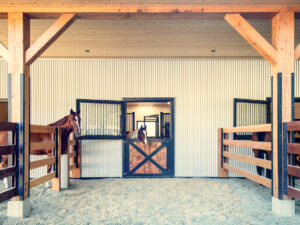
- Stress Reduction: Open designs with visibility reduce boredom and pacing, while privacy partitions give nervous horses a calmer space.
👉 Decision Point: A quiet, chew-resistant stall reduces stress for both horses and caretakers. Less maintenance.
Visibility for Horses (Grilled vs. Solid Partitions)
- Grilled Partitions: Promote social interaction and a more open feel. Horses see and smell each other, which lowers stress for social animals.
- Solid Partitions: Provide isolation for horses that don’t get along, mares with foals, or stallions. They reduce stress from aggressive encounters but can feel more confining.
- Privacy Partitions: A hybrid approach with solid lower panels and grilled upper sections accept for 48” – 60” of solid wall gives horses the option of both interaction and solitude.
👉 Decision Point: Tailor partitions to horse temperament. Not every horse benefits from full visibility, but few thrive in complete isolation.
Safety & Welfare Comparison
| Factor | Best Practices | Why It Matters |
| Bar Spacing | 2” standard, 7/8”–1” diameter hollow bars | Prevents entrapment, ensures strength |
| Kick Protection | Solid kickboards, chew guards | Protects horses, extends stall life |
| Airflow | Grills, mesh, Dutch doors, ridge vents | Reduces ammonia & respiratory stress |
| Dust Control | Stable comfort matting, low-dust bedding | Keeps air cleaner |
| Noise Reduction | Quality rollers, quiet latches, buffers | Reduces horse anxiety |
| Chew Resistance | Metal guards, HDPE or eco-board | Prevents damage, improves safety |
| Visibility | Grilled/mesh for social, solid for privacy | Supports horse welfare & behavior |
8. Cost Drivers
The cost of a horse stall is shaped by multiple factors—some obvious, some hidden. Understanding these drivers helps barn owners set realistic budgets and make informed trade-offs.
Stall Front Type (Sliding vs. Euro)
- Sliding Fronts: Generally the most economical. Less material is required, and they fit more efficiently into narrow aisles.
- Euro / Hinged Fronts: Premium option, with added steel, heavier hinges, and often decorative arches or custom yokes. The aesthetic value comes with a higher price tag.
👉 Cost Impact: Sliding fronts can save 20–40% compared to Euro fronts.
Finish Choice (Galv vs. Powder Coat vs. Stainless)
- Galvanized Steel: Baseline cost, durable, and low-maintenance.
- Powder Coat over Galv: Adds color and aesthetic appeal, with a 15–25% cost increase. Requires proper surface prep for long-term performance.
- Stainless Steel: The premium finish, with costs 2–3x higher than standard galvanized. Used in high-end barns or coastal regions where salt corrosion is a concern.
👉 Cost Impact: Finish choice alone can swing the price of a project dramatically, especially across multiple stalls.
Lumber Inclusion
Many kit stalls are priced for steel only, leaving owners to supply and install their own lumber. This can add thousands of dollars in material and labor costs, depending on the wood selected:
- Spruce: Low-cost, but less durable.
- Oak or Ash: Strong and attractive, but higher-priced.
- HDPE / Recycled Plastic: Durable, chew-resistant, and long-lasting, but more expensive up front.
👉 Cost Impact: Wood choice can shift stall pricing by 20–30%. Always check if lumber is included in the quoted price.
Accessories and Upgrades
- Feed Doors, Swivel Feeders, Automatic Waterers, Blanket Bars: Each upgrade adds incremental cost, but also efficiency and horse welfare.
- Chew Guards, Kick Plates, Mesh Panels: Protect stalls from damage and extend lifespan, but add to upfront investment.
👉 Cost Impact: Accessories can add anywhere from $200–$1,000+ per stall depending on the level of outfitting.
Freight & Delivery
- Freight Mode: Most stalls ship LTL (less-than-truckload). Rates depend on distance, weight, and whether delivery is to a business, farm, or rural location.
- Surcharges: Rural delivery fees and liftgate charges can add significant costs. Helps if you and a neighbour can go in together.
- Cross-Border Shipping: No issues moving stalls between Canada and the U.S. and Mexico.
👉 Cost Impact: Delivery can represent 10–20% of the total stall project cost, especially for smaller orders traveling long distances.
Installation Costs (DIY vs. Professional Install)
- DIY Installation: Kit stalls are designed for horse owners or local contractors to assemble. Saves money but requires tools, labor, and accuracy.
- Professional Install: Fully welded systems or complex Euro fronts often require experienced crews. While costlier, they reduce errors and speed up the project.
👉 Cost Impact: Professional installation can add 20–30% to project costs, but often saves time and ensures long-term performance.
Summary: Key Cost Drivers
| Factor | Low-Cost Choice | Premium Choice | Cost Impact |
| Front Type | Sliding | Euro/Hinged | 20–40% higher for Euro |
| Finish | Galvanized | Stainless | 15–200% increase depending on finish |
| Lumber | Spruce | Oak, HDPE, Ash | 20–30% swing |
| Accessories | Basic setup | Feed doors, waterers, guards | $200–$1,000+ per stall |
| Freight | Local delivery | Rural, long-distance LTL | 10–20% of project |
| Installation | DIY | Professional crew | 20–30% project cost |
Here’s a polished draft for Section 9: The Good / Better / Best Model (System Equine), tying System Equine’s stall lines directly into the framework you introduced in Section 1.
The Good / Better / Best Model (System Equine)
One of the most effective ways to compare stall systems is through a Good / Better / Best framework. At System Equine, our stall product lines naturally fit this progression—ranging from practical, budget-conscious kits to premium Euro-style showcase stalls.
Good: Standard Stall Kits (Value Option)
- What they are: Bolt-together kits with galvanized steel, sliding fronts, and optional add-ons.
- Why choose it: Safe, functional, and affordable—ideal for barns looking for dependable stalls without the cost of premium finishes.
- Best fit: Private barns, smaller operations, or those building on a tighter budget who still want professional-grade systems.
Better: Freedom Stall Series (Flexible, Customizable)
- What they are: Modular stalls with both sliding and hinged front options, available in galvanized or powder-coated finishes. Designed to be more customizable than standard kits. System requires no posts in the barn.
- Why choose it: Balance between value and aesthetics. Freedom stalls allow for grill/solid partition mixes, powder coat colors, and add-ons like feed doors or blanket bars.
- Best fit: Boarding barns or mid-sized facilities where flexibility, durability, and appearance all matter.
Best: Des Coteaux Euro-Style Stalls (Premium Showcase Option)
- What they are: Fully welded, premium Euro fronts with arched or curved lines, open yokes, and luxury finishes. Often powder coated or stainless steel, with custom wood or HDPE infill.
- Why choose it: Creates a high-end, European aesthetic while delivering excellent airflow and socialization opportunities for horses. These stalls are a centerpiece, adding prestige to the barn.
- Best fit: Showcase barns, show facilities, or private owners who want their barn to reflect top-tier design and craftsmanship.
Where Each Fits
| Tier | Stall Line | Key Features | Best Fit |
| Good | Standard Stall Kits | Bolt-together kits, galvanized, sliding fronts | Private barns, budget builds |
| Better | Freedom Series | Modular, sliding or hinged, powder coat options, customizable | Boarding barns, mid-sized barns |
| Best | Des Coteaux Euro | Premium Euro fronts, welded, powder coat or stainless, custom infill | Show facilities, luxury private barns |
👉 This framework makes it easy for horse owners, barn managers, and architects to align budget, function, and aesthetics when choosing the right stall system.
Competitor Benchmarking (Canada & U.S.)
When comparing stall quotes between suppliers—whether Canadian brands like Miracle Ranch Equipment, Livestock Equipment Canada, or System Equine, or U.S. suppliers such as Priefert, WW, RAMM, and Blackwood—the numbers only tell part of the story. To make a fair comparison, it’s critical to look deeper than the sticker price.
What to Look for When Pricing a Stall
- Grill Height & Partition Design
- Higher grills improve airflow and visibility but also require more steel and labor.
- Lower grills or partial partitions may reduce cost, but change airflow and horse interaction.
- Bar Spacing & Bar Diameter
- Standard bar spacing is 2 inches for safety. Anything wider may risk entrapment.
- Typical bar diameters are 7/8”, with ¾” or 1” available. Larger diameters increase strength and weight.
- Overall Weight of the Stall
- Heavier stalls generally mean more steel and a stronger frame.
- A lighter stall may look similar, but won’t perform the same under heavy use.
- Gauge of Steel
- 12-gauge steel is standard for high-quality stalls. Thinner gauge (higher number) reduces cost but compromises strength and longevity.
- Steel Type & Finish
- Galvanized Steel: Baseline rust protection.
- Powder Coat over Galv: Adds color and additional protection—make sure the base is galvanized first.
- Hot-Rolled vs. Cold-Rolled Steel: Cold-rolled provides smoother finishes and tighter tolerances, while hot-rolled is less refined but more economical.
- Stainless Steel (304 vs. 316): 304 works inland; 316 is required for coastal barns.
- Lumber Inclusion
- Many kit stalls are sold without lumber. Make sure quotes specify whether wood (and what type) is included. Southern Yellow Pine is cheapest; Oak, Ash, and HDPE are premium.
- Accessories & Upgrades
- Feed doors, swivel feeders, blanket bars, bridle hooks, chew guards, automatic waterers—each adds value but also cost. Always confirm what’s included.
- Freight & Delivery
- Shipping method (LTL, full truckload), rural delivery fees, and handling charges vary widely. Make sure delivery is quoted alongside stall pricing.
- Installation
- DIY kits are cheaper but require skill and labor. Professional installation adds 20–30% but ensures accuracy and speed.
Apples-to-Apples Comparison
When reviewing competitor quotes:
- Ask for a sign-off sheet detailing grill height, bar spacing, bar diameter, gauge of steel, finish (galv/powder coat/stainless), and whether lumber is included.
- Request drawings or CAD files where possible so you can see exactly what is being supplied.
- Don’t assume two quotes are equal just because the front cost looks similar. A lighter-gauge, non-galvanized, non-lumber-included kit might be half the price of a heavy-gauge, powder-coated, lumber-included welded front—but they are not the same product.
Why This Matters
Stalls are a 15–20 year investment. A cheaper initial quote may cost more in the long run through repairs, replacements, or safety issues. System Equine positions itself by providing transparent specifications and sign-offs so customers know exactly what they’re getting, ensuring comparisons are fair.
Sample sheet to compare stall companies:
Stall Quote Comparison Checklist
Make sure every quote you review includes the following details.
1. Stall Fronts
- Type of front: ☐ Sliding ☐ Euro/Hinged
- Grill height (___ in.)
- Bar spacing (___ in. standard is 2”)
- Bar diameter (☐ ¾” ☐ 7/8” ☐ 1”)
- Kick plate included? ☐ Yes ☐ No
2. Steel & Finish
- Steel gauge (___ gauge; 12 gauge is premium)
- Type: ☐ Galvanized ☐ Pre-Galv + Powder Coat ☐ Hot-Dip Galv ☐ Stainless (☐ 304 ☐ 316)
- Is the steel galvanized under the powder coat? ☐ Yes ☐ No
- Hot-rolled or cold-rolled steel? ☐ Hot-Rolled ☐ Cold-Rolled
3. Partitions
- Type: ☐ Grilled ☐ Solid ☐ Privacy (___ % grilled)
- Infill: ☐ Bars ☐ Mesh
4. Lumber / Infill Materials
- Included in quote? ☐ Yes ☐ No
- Type: ☐ Spruce ☐ Oak ☐ Ash ☐ HDPE/Recycled ☐ Other __________
5. Accessories & Upgrades
- Feed door ☐ Yes ☐ No
- Hay door ☐ Yes ☐ No
- Swivel feeder ☐ Yes ☐ No
- Automatic waterer ☐ Yes ☐ No
- Blanket bars / bridle hooks ☐ Yes ☐ No
- Chew guards ☐ Yes ☐ No
6. Weight & Strength
- Overall stall weight (___ lbs / kg per front)
- Reinforcement details included? ☐ Yes ☐ No
7. Freight & Delivery
- Freight included? ☐ Yes ☐ No
- Delivery method: ☐ LTL ☐ Full Truckload
- Rural / liftgate surcharges included? ☐ Yes ☐ No
8. Installation
- DIY or professional installation? ☐ DIY ☐ Pro Crew
- If pro install: labor cost included? ☐ Yes ☐ No
Freight, Duties & Tariffs
When pricing stalls—especially in Canada and the U.S.—freight and tariffs are often overlooked until the final invoice. These factors can meaningfully impact the landed cost of a project.
Canadian Tariffs on Imported Steel & Aluminum
As of 2025, there are tariffs on imported steel and aluminum products moving between Canada and the U.S. These duties are calculated on the value of the steel in the shipment, not on freight or accessories.
- Impact in Canada: Canadian stall manufacturers face higher input costs when importing steel or aluminum from the U.S.
- Impact in the U.S.: U.S. manufacturers have also seen steel prices increase, narrowing the competitive gap between Canadian and American suppliers.
👉 For buyers, this means Canadian stalls are still highly competitive in the U.S. market, because everyone is paying more for raw steel.
Cross-Border Shipping Realities (CAD vs. USD Pricing)
- Currency Exchange: At System Equine we quote all of our American customers in USD;
- Freight Class & Customs: Stall fronts and partitions typically ship on skids as LTL freight (Less-Than-Truckload). Customs paperwork is routine, and System Equine manages this process regularly for U.S. customers.
- No Supply Issues: There are no restrictions preventing stalls from moving across the border—only added duty costs to account for.
LTL Delivery Best Practices
- Packaging: Stalls should be shipped on well-secured skids, with padding on powder-coated or stainless components. Use wood and foam between stalls.
- Carrier Choice: Using reliable LTL carriers reduces damage risk. Be cautious of “lowest-cost” freight brokers, as damaged goods cost more in the long run.
- Rural Surcharges: Delivery to farms often triggers extra fees for liftgates or rural routes. Always confirm these in the quote.
- Communication: Clear coordination with customers ensures drivers can access barns or storage areas without delays.
Why System Equine Remains Competitive
Even with tariffs, System Equine remains cost-competitive in the U.S. because:
- Steel costs have risen for all manufacturers—American suppliers face the same raw material pressures.
- System Equine’s scale and in-house fabrication (tube lasers, welders, powder coat) allow tighter control of costs.
- Cross-border logistics expertise means shipments are handled smoothly, without delays or surprise fees.
Key Takeaways for Buyers
- Always ask whether tariffs and duties are included in your stall quote.
- Confirm whether pricing is listed in CAD or USD.
- Compare landed costs (product + freight + duties) rather than base product prices.
- Factor in rural or liftgate fees if delivery is to a farm.
Installation Options
A stall system is only as good as its installation. Even the best materials and designs will underperform if not installed correctly. Owners have two main pathways: DIY installation or professional installation.
DIY Installation
- Skills Required: Basic carpentry and construction skills are essential. Installing kit stalls means working with posts, channels, bolts, and lumber.
- Tools Needed: Power drills, levels, impact drivers, measuring tapes, and sometimes masonry anchors for concrete work.
- Time Commitment: Depending on crew size, installing a single stall front with partitions can take several hours. A 4–6 stall barn may require a weekend or more for an experienced DIY crew.
- Pros: Saves on installation costs, flexible timing, and satisfying for hands-on owners.
- Cons: Mistakes in leveling or anchoring can shorten stall life or compromise safety.
Professional Installation
- System Equine Services: System Equine provides professional installation services, ensuring stalls are set up correctly and efficiently.
- Local Installers: For projects outside our direct service area, we work with trusted builders across Canada and the U.S. who are familiar with our systems.
- Pros: Faster turnaround, professional finish, warranty protection, and peace of mind.
- Cons: Higher upfront labor cost compared to DIY.
Site Preparation
Proper site prep is the foundation of a successful stall installation:
- Concrete: Level pads with correct slope and thickness for anchors.
- Posts: Wood or steel posts need to be plumb, aligned, and secured before fronts or partitions are mounted.
- Flooring: Stone dust, concrete pads, or mattress systems must be compacted and leveled before stall mats or mattresses are placed.
- Anchors: Stalls must be bolted or fastened securely to prevent shifting.
👉 Tip: The better the prep, the smoother and longer-lasting the installation.
Typical Timelines
- DIY: 1–2 stalls/day depending on complexity and experience.
- Professional Install: Full barn installations (10–12 stalls) can often be completed in 2–4 days with a trained crew.
- Coordination: System Equine works with builders across the country to match the installation timeline with your barn construction schedule.
Summary Comparison
| Option | Pros | Cons | Best Fit |
| DIY Install | Save labor cost, flexible timing | Requires skills, more time, risk of mistakes | Hands-on owners, small barns |
| Professional | Fast, guaranteed quality, works with barn builders | Higher upfront cost | Boarding barns, show barns, large projects |
| Site Prep | Critical for long-term stability | Adds time/cost | All barns—cannot be skipped |
Pre-Install Checklist
System Equine Stall Systems
1. Site Preparation
- Concrete or Stone Dust Base prepared, compacted, and level
- 6″ of limestone screenings (stone dust), compacted in 2–3″ lifts
- Final grade checked with level and straight edge
- Posts set (if applicable) — plumb and aligned
- Flooring (mats or mattress system) area ready for install
2. Tools & Equipment
- Power drill / impact driver
- Level (4 ft. or laser recommended)
- Tape measure
- Hammer drill (for concrete anchors if required)
- Wrenches & sockets (for bolts and hardware)
- Safety gear: gloves, glasses, boots
3. Stall Components
- Stall fronts and partitions delivered on-site
- Lumber or HDPE boards on-site (if not included in stall package)
- Hardware: bolts, latches, rollers, hinges, anchors checked against packing slip
- Accessories (feed doors, waterers, blanket bars, etc.) ready
4. Manpower & Timing
- Crew assigned (2+ people recommended for efficiency)
- Time allocated:
- DIY: 1–2 stalls per day depending on experience
- Pro Installers: 10–12 stalls can be completed in 2–4 days
- Builder/contractor coordination confirmed (if stalls are part of larger barn project)
5. Final Checks Before Install
- Confirm aisle widths and stall dimensions against plans
- Power available on-site for tools
- Delivery area clear and accessible for skids
- All drawings/spec sheets reviewed and signed off
✅ Tip: A level and properly compacted base is the single most important factor for a smooth, long-lasting installation. The better the prep, the better the stall performance.
ROI & Long-Term Value
High-quality stalls are an investment that pays back in both direct and indirect ways. Beyond initial installation, the right stall system contributes to horse welfare, operational efficiency, and even property value.
Horse Welfare & Reduced Vet Costs
- Fewer Injuries: Proper bar spacing, solid kick protection, and chew-resistant materials prevent accidents that often lead to expensive vet bills.
- Healthier Environment: Good ventilation, dust control, and comfort-focused flooring systems reduce respiratory issues, lameness, and stress-related behaviors.
- ROI: Even one avoided vet emergency (e.g., a $2,000+ colic bill or $1,500 leg injury) can justify higher-quality stalls. Over years, these welfare-driven savings add up.
Time Savings (Integrated Features)
- Sliding Doors: Save seconds every time a stall is opened or closed, especially in busy barns with many horses.
- Feed & Hay Doors: Reduce labor by allowing feeding from the aisle, limiting risk to staff.
- Automatic Waterers: Save daily bucket-filling time, especially in large barns.
- Swivel Feeders & Accessories: Streamline chores and keep barns cleaner.
👉 In a 20-horse barn, integrated features can save 1–2 hours of staff time per day. At labor rates of $20–25/hr, that’s $7,000–$10,000 annually in time savings.
Resale Value of Property with Quality Stalls
- Attractiveness to Buyers: Well-designed, professional-quality stalls are a selling feature for equestrian properties, often commanding a premium price.
- Durability: Powder-coated finishes, stainless upgrades, and eco-board infill ensure stalls look new longer, adding to property presentation.
- Market Perception: Buyers are more likely to pay a premium for a barn that is “move-in ready” with safe, durable stalls, versus one that requires upgrades.
ROI Snapshot
| Factor | Impact | ROI Over Time |
| Vet Costs | Reduced injuries & stress = fewer bills | Thousands saved in avoided emergencies |
| Labor Savings | Doors, feeders, waterers save hours daily | $7k–$10k/year in staff time |
| Property Value | High-end stalls boost sale appeal | 5–10% added to resale value of barn |
✅ Key Takeaway: Stalls are not just a cost—they’re an asset. When measured in terms of welfare, efficiency, and resale, quality stalls pay for themselves many times over.
Procurement Checklist
When planning a barn project, it’s easy to focus only on price or looks. But the right procurement process ensures you get stalls that are safe, durable, and aligned with your barn’s long-term purpose. Use this checklist to guide your decisions:
1. Define Your Barn’s Purpose
- Private Barn – lower traffic, can focus on aesthetics and personal preferences
- Boarding Barn – durability, efficiency, and staff-friendly features are key
- Training or Show Facility – showcase quality, airflow, and professional image matter most
2. Decide on Good / Better / Best Tier
- Good – Standard Stall Kits (value option, bolt-together, galvanized)
- Better – Freedom Stall Series (flexible, customizable, powder coat options)
- Best – Des Coteaux Euro (premium Euro-style, welded, stainless/powder coat)
3. Select Finish for Your Climate
- Canada (snow/condensation) – Hot-dip galvanized or powder over galv
- U.S. South (heat) – Powder coat for aesthetics, mesh/grilled for ventilation
- Coastal (salt air) – 316 stainless or hot-dip galvanized + marine-grade finish
4. Choose Lumber / Infill Type
- Spruce / Pine – economical, lower durability
- Oak / Ash – strong, premium appearance
- HDPE / Eco-Board – chew-proof, rot-resistant, eco-friendly
- Other: _____________________
5. Accessories to Include Now vs. Later
- Feed doors / hay doors
- Swivel feeders
- Automatic waterers
- Blanket bars & bridle hooks
- Chew guards / kick plates
(Tip: Accessories can be added later, but are cheaper and faster to install up front.)
6. Freight & Install Plan
- Confirm freight costs, surcharges, and delivery method (LTL, liftgate, rural)
- Decide: ☐ DIY Install ☐ Professional Install
- Site prep completed: concrete, posts, flooring, anchors
7. Confirm Warranty & Service Support
- Get warranty terms in writing (finish, structure, hardware)
- Confirm local service or System Equine installer support if needed
- Request a sign-off sheet with CAD drawings or specs to confirm “apples-to-apples” comparison
✅ Key Takeaway: Stalls are a 20-year investment. Taking the time to define purpose, choose the right finish and lumber, and confirm freight, install, and warranty support ensures long-term value and peace of mind.
Conclusion & Next Steps
Investing in the right stall system isn’t just about looks—it’s about protecting horses, saving time and money, and increasing the long-term value of your property. From choosing the right materials and finishes to ensuring proper installation and climate considerations, every decision shapes the safety, efficiency, and comfort of your barn for years to come.
System Equine offers a complete range of stall systems, from entry-level kits to premium Euro fronts, all backed by decades of expertise and a commitment to horse welfare. With CAD drawings for architects, national installer networks, and transparent pricing, we make it easy to compare options and find the solution that fits your barn’s goals.
Next Steps
- Request a Quote:
- Request a Stall System Quote – Canada
- Request a Stall System Quote – U.S.
- Download a Budget Worksheet (optional gated content):
- Plan your project with a downloadable worksheet that helps you define stall type, finishes, accessories, freight, and installation costs in advance.
- Available through System Equine’s website (contact page or resources section).
- Talk to Our Team: Whether you’re building a private barn, upgrading a boarding facility, or designing a showpiece property, our specialists will walk you through every step—from design to installation.
✅ Key Takeaway: The right stall system is a long-term investment in horse welfare, barn efficiency, and property value. By planning carefully and partnering with System Equine, you ensure your barn delivers both peace of mind and performance for years to come.