Farm gate supply and installation — sized right, hung right, built to last
The right gate for every opening on your farm — starting with getting the width right.
A gate is the most-used part of your fence. It gets opened and closed multiple times every day, in every kind of weather, often by one hand while the other is managing a horse. Getting the width wrong means daily frustration. Getting the product wrong means a gate that sags, drags, and fails long before it should. System Fence has been supplying and installing farm gates across Ontario since 1987. Here is how to choose the right one.
How Wide Does Your Gate Need to Be?
How wide is wide enough? It depends entirely on what is going through it.
Gate width is the first and most important decision you will make. Too narrow and the gate creates a daily problem — squeezing horses through, scraping tractor tyres, struggling to turn equipment. Too wide and you are spending more than you need to. Here is the practical guide for Ontario horse farms.

A 6-foot gate is the minimum width for a horse paddock gate where the primary use is leading a single horse in and out by hand. It gives you enough room to walk beside the horse without crowding the gate frame. It is not wide enough for any machinery and should only be used where you are certain no tractor or equipment will ever need access.

Most compact tractors can physically pass through an 8-foot gate, but there is very little margin. A moment of inattention and you are scraping the gate or the post. If you know for certain you will only ever use a small tractor and the approach is straight, an 8-foot gate can work. In practice, we recommend 10 feet for any opening that a tractor needs to use regularly. The extra two feet costs very little and removes the stress entirely.

A 10-foot gate gives a standard farm tractor comfortable clearance and is the right starting point for any paddock or field gate where machinery needs to enter. You can drive through without holding your breath, and there is room for a loader bucket or implement to clear the posts. If you are planning your farm and you are not sure whether you will need tractor access — plan for 10 feet. You will thank yourself later.

If your gate is at the entrance to a chute, a laneway, or any location where a tractor, truck, or trailer needs to turn in from the road or a field track, 12 to 14 feet is the right range. The reason is not just the width of the vehicle — it is the arc of the turn. When a truck and trailer swings into a laneway, the trailer follows a wider arc than the truck. A 10-foot gate that a truck can pass through straight-on may still be impossible to enter with a loaded horse trailer turning from a road. A 12 to 14-foot opening gives you the width to begin the turn, get the trailer tracking straight, and pull through cleanly without jackknifing or cutting a corner post.
6 feet
One horse in and out on foot. No machinery. Paddock walk-through only.
8 feet
Small tractor in a straight run. Tight but possible. We recommend 10’ instead.
10 feet
Standard tractor access. Our recommended minimum for any gate a tractor uses regularly.
12 feet
Truck or tractor turning into a laneway. Comfortable entry with a wide implement.
14 feet
Truck and trailer turning in from a road or field. Recommended for laneway entrances off a road.
16’+
Double gate configurations for wide equipment, combines, hay wagons. Two gates hung from a centre post.
A gate placed in the corner of a paddock creates a crowding risk — horses anxious to come in push into the corner and can trap whoever is opening the gate. A gate placed in a straight fence line, away from corners, with clear space on both sides gives you the room to manage the gate and the horse safely. If you are planning new gate locations, discuss placement with our team before the fence goes in. Moving a gate after the fact is expensive.
Our gate range
Four gate families. Every application covered.
System Equine carries a complete range of farm and equine gates — from lightweight aluminum paddock gates through to heavy-duty steel farm gates for high-pressure livestock areas. Choosing the right gate is about matching the product to the pressure it will face, the animals it is containing, and the aesthetic of your property.
Aluminum 6 Bar Diamond Gate
- Lightweight aluminum construction — easy to open and close one-handed
- 6061 T5 high-tensile grade aluminum tubing — bull-rated strength from a lightweight gate
- Diamond-pattern bars provide excellent strength without excess weight
- 48″ standard height — appropriate for horse paddocks
- Rust-proof by nature — aluminum does not corrode
- Available in natural aluminum finish or can be painted black for a premium look
- Save your back and your posts — the weight is a fraction of a comparable steel gate
- True to size — the width you order is the width you get
Best for: Horse paddocks, pasture entry points, equine facilities of all types
Why We Recommend Painting Them Black
A painted black aluminum 6 Bar Diamond gate is one of the sharpest-looking gates you can put on a horse farm. Black powder coat against white Flex Fence or white board fence creates a clean, intentional contrast that reads as professional and well-considered. If you are investing in quality fencing, the gate should match. We recommend black for any property where appearance matters — which is most of them.

3-Rail & 4-Rail Painted Aluminum Paddock Gates
- 2×6 aluminum tubing — exceptional durability and rust resistance
- Sandblasted before powder coating for a finish that bonds properly and lasts
- Black is standard — matches the aesthetic of a premium horse farm or barn
- Custom RAL colours available for properties with a specific colour scheme
- 3-rail and 4-rail configurations — 4-rail preferred for horse paddock use
- Designed for easy installation on 3/4″ hinge bolts
- Compatible with 2-way latch for convenient entry and exit
- Clean, ranch-style appearance that complements Flex Fence, PVC, and board fence
Best for: Horse paddocks, farm driveways, equestrian properties where appearance is a priority

Aluminum Mesh Diamond Gate
- Lightweight aluminum frame with diamond mesh panel insert
- Good choice for sheep, goats, alpacas, and mixed small livestock
- Keeps smaller animals contained where a bar-only gate would allow escape
- Lightweight and easy to handle
- Important: the mesh insert is not suitable for horses — horses can damage or distort the mesh panel
- System Equine advises against this gate in horse paddocks or any area where horses will be in contact with the gate
Best for: Sheep paddocks, goat yards, alpaca enclosures, small livestock areas — not horse paddocks
A painted black aluminum 6 Bar Diamond gate is one of the sharpest-looking gates you can put on a horse farm. Black powder coat against white Flex Fence or white board fence creates a clean, intentional contrast that reads as professional and well-considered. If you are investing in quality fencing, the gate should match. We recommend black for any property where appearance matters — which is most of them.
*The mesh inserts in these gates are not impervious to destructive equine nature and may be damaged by more unruly horses or other animals.
True North Farm Gates — Grey Steel
- Heavy-duty steel construction — made in Canada
- Grey finish — the recognizable colour of a working farm gate
- 4 feet high and available in widths up to 18 feet
- 4-bar and mesh configurations available
- Built to contain cattle and horses under working farm conditions
- Rated for livestock pressure — holds up to repeated use by large animals
- Comes with welded chain latch and 3/16″ zinc-plated chain
- Straightforward installation — true to stated length
Best for: Horse paddocks, cattle containment, working farm laneways, any high-pressure livestock area
True North Grey Gates for Horse Areas — Our Recommendation
The True North farm gate in grey is a strong, dependable gate that will stand up to the pressure horses and cattle put on a gate. If you have a working farm where the gate is going to take a beating from large animals, this is the gate to specify. It is heavier than aluminum but built for exactly this kind of use. For horse paddocks where weight is a consideration, the aluminum 6 Bar Diamond is the alternative. For high-pressure areas where strength is the priority, the True North grey gate delivers.
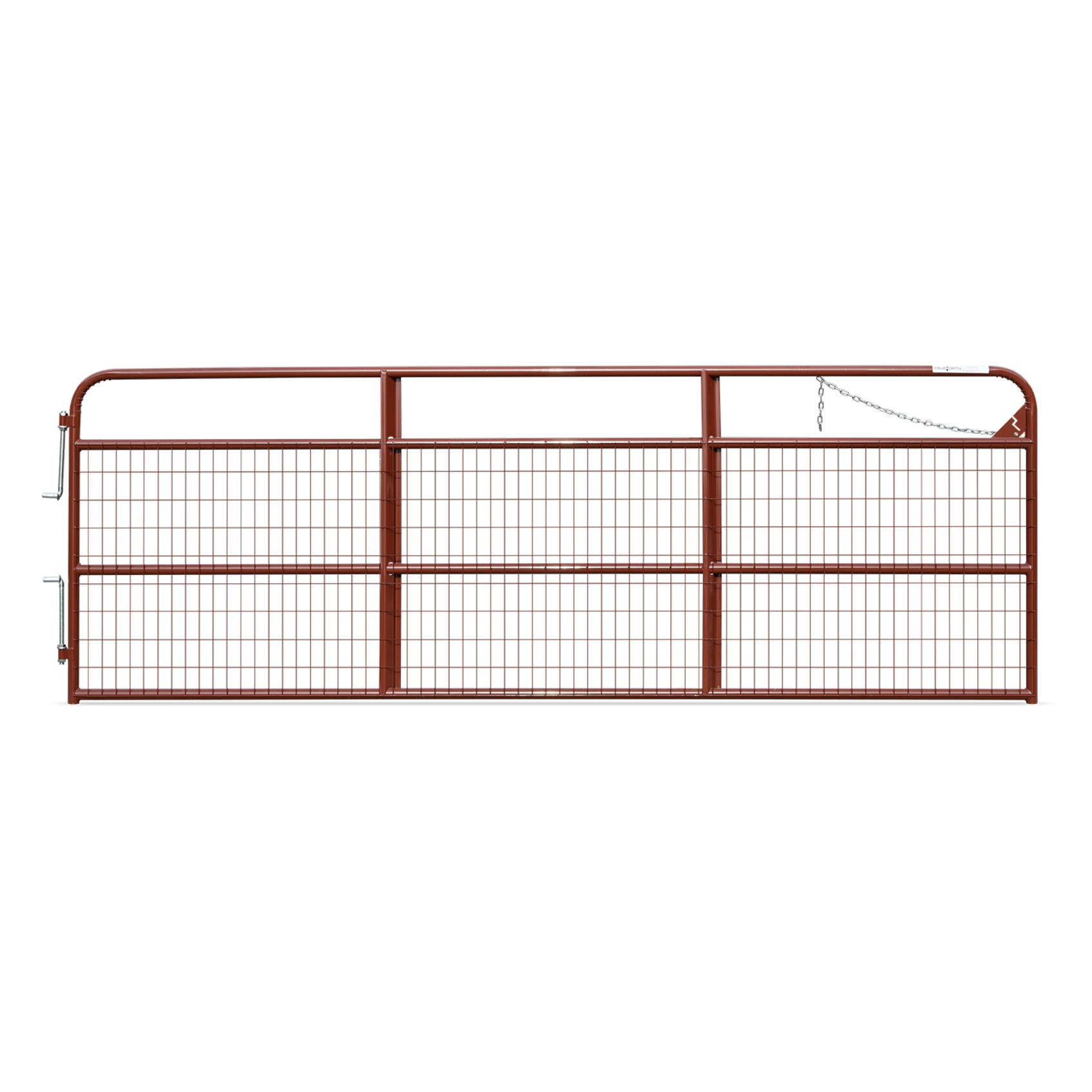
Economy Farm Gates — Red Steel
- 4-bar mesh and 6-bar configurations available
- Ideal for driveway entrances, bush lanes, field access points, and pastures
- Easy to install and available in a wide range of lengths
- Comes with welded chain latch and 3/16″ zinc-plated chain
- 6-bar version has variable bar spacing — lower bars closer together for small livestock
- Lower cost per gate than True North or aluminum options
Best for: Farm driveways, bush lanes, field access gates, pasture entrances without regular animal pressure
Economy gates are not for horse paddocks
The economy red gate range is an excellent choice for a farm driveway entrance, a bush lane gate, or any opening where the gate controls vehicle access rather than animal containment. They are not the right choice for horse paddocks or any area where horses will be in regular contact with the gate. Horses will test an economy gate and the lighter construction is not built for that kind of pressure. Use the right gate for the job — and in horse areas, that means aluminum or True North grey steel.
Match the gate to the job. This is the decision that saves you money.
Every gate failure we have seen — sagging hinges, bent frames, damaged mesh, broken latches — traces back to the same root cause: the wrong gate for the pressure it was put under. Use this table as a starting point.
Single horse in and out by hand
Aluminum 6 Bar Diamond (6’–8’)
Horse paddock — regular daily use
Aluminum 6 Bar Diamond or Painted Aluminum Paddock Gate
High-pressure horse area — stallion, corral
True North grey steel farm gate
Cattle paddock or livestock area
True North grey steel farm gate
Sheep, goats, alpacas — small livestock
Aluminum Mesh Diamond Gate (suitable for these species)
Tractor access — paddock or field
Aluminum 6 Bar Diamond or True North (10’ minimum)
Truck and trailer — laneway entrance
Farm driveway — vehicle access only
Economy red gate (4-bar or 6-bar) or True North
Bush lane or field access — no animals
Economy red gate — suitable and economical
Appearance is a priority — horse barn
Aluminum 6 Bar Diamond or Painted Aluminum, painted black
What We Do
A gate is only as good as how it is hung.
The best gate in the world will sag, drag, and fail within a season if it is not hung correctly. Post sizing, post depth, hinge specification, and gate hang are all critical. This is what System Fence installation covers as standard.
We talk through your application, your animals, and your equipment needs. We recommend the right gate type and width for each opening before anything is ordered. Changing a gate opening after the fence is installed is expensive — we get the specification right from the start.
Post sizing and installation
Gate posts must be heavier than line posts — they carry the full weight and dynamic load of the gate. We size gate posts for the gate weight and width, install them at the correct depth, and concrete-foot any post supporting a wide or heavy gate. A gate post that moves is a gate that will always be out of alignment.
Hinge specification
Hinge type and number are matched to gate weight. An undersized hinge on a heavy farm gate will bend and fail under repeated use. We install the right hinge for the gate — and install enough of them. Two hinges on a 14-foot gate are not enough.
Gate hang and alignment
The gate is hung level and plumb, tested for full range of motion, and latched to confirm the latch lines up correctly before we leave. A gate that needs to be lifted to close on day one will only get harder to use as posts settle. We hang gates to close and latch cleanly from the start.
Gate wheel and support (where required)
For wider gates — particularly 16 feet and above — we install a gate wheel on the free end to support the gate weight and prevent sag. A gate without support on a wide span will sag and drag within a season. We include this in the installation specification for any gate where it is needed.
Latch and hardware
Gate latch is installed and adjusted for smooth, reliable operation. For horse paddocks, we use a latch that horses cannot work open — horses are persistent and creative. For vehicle-access gates, we confirm the latch is accessible from a vehicle or tractor without needing to dismount.
On gate sag — a note from 39 years of experience
Once a gate starts to sag, it gets worse quickly. The weight of the gate on a bent hinge accelerates the bend. The dragging free end creates ruts that make the problem worse. A sagging gate is not just frustrating — it is a safety issue in a horse paddock because a gate that does not close cleanly and latch reliably is a gate that can let animals out. Install correctly from the start and the gate will give you years of reliable service.
Farm gate installation — common questions
The Aluminum 6 Bar Diamond gate is our top recommendation for most horse paddocks. It is lightweight enough to open and close easily one-handed — which matters when you are managing a horse with the other hand — but built to a bull-gate strength rating. For paddocks where appearance matters, paint it black. For high-pressure areas like stallion paddocks or corrals, the True North grey steel farm gate is the stronger choice.
Aluminum is our standard recommendation for horse paddocks. It does not rust, it is significantly lighter than steel of comparable size — which saves wear on your hinges and your back — and it handles daily use from horses without issue. Steel in the True North grey range is the right choice for high-pressure livestock areas, cattle paddocks, and any situation where maximum structural strength is the priority over weight.
We do not recommend it. The mesh insert in aluminum mesh gates is not built to withstand the contact behaviour of horses — pushing, leaning, and working at the gate with their teeth. The mesh can be deformed or damaged, creating sharp edges or gaps. For horse paddocks, use the 6 Bar Diamond or the painted aluminum paddock gate. Save the mesh gates for sheep, goats, alpacas, and other small livestock where they are well-suited and safe.
Ten feet is our standard recommendation for any gate a tractor uses regularly. A tractor can physically pass through an 8-foot opening but there is very little margin and it becomes stressful in wet or muddy conditions when you cannot drive a perfectly straight line. The extra two feet on a 10-foot gate costs very little and eliminates the problem entirely.
If the gate is at a road entrance or a point where a truck and trailer needs to turn in, plan for 12 to 14 feet minimum. The critical factor is not the width of the truck — it is the arc of the turn. A loaded horse trailer following a truck through a gate makes a wider sweep than the truck itself. A 10-foot gate that a truck can drive through straight may still require a difficult multi-point turn with a trailer. At 12 to 14 feet, the turn becomes clean and stress-free.
A gate post carries the full static weight of the gate hanging on its hinges plus the dynamic load every time the gate swings open and closed. That is a very different stress than a line post that simply holds a fence rail in tension. Under-specified gate posts settle, lean, and cause the gate to go out of alignment. We size gate posts for the specific gate they are supporting and concrete-foot any post carrying a wide or heavy gate.
Horse-proof latches are a real consideration. Horses are curious and persistent, and a standard spring latch that works fine for cattle can sometimes be worked open by a determined horse. We use latch hardware appropriate to the animals being contained — a latch that requires a two-step operation or a positive downward motion to open is generally horse-proof. We discuss latch selection as part of every paddock gate installation.
Yes. All gates are supplied from System Equine’s own inventory — aluminum 6 Bar Diamond, painted aluminum paddock gates, True North grey steel, economy red gates, and all associated hardware. We supply and install from the same source, which means product consistency and no delays waiting on outside suppliers.
Browse the complete System Equine gate range.
Every gate we install is available to view on the System Equine website with full specifications, sizing options, and availability information. Use the links below to explore each product before your consultation.
Aluminum 6 Bar Diamond Gate
Lightweight. Bull-rated. Our top recommendation for horse paddocks. Paint it black
3-Rail Painted Aluminum Paddock Gate
Premium ranch-style gate. Sandblasted and powder coated. Black standard, custom RAL available.
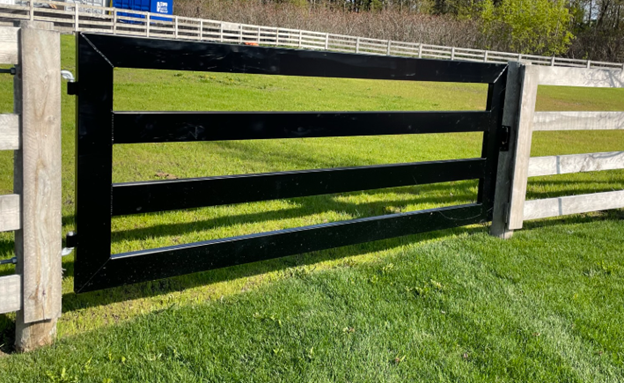
4-Rail Painted Aluminum Paddock Gate
Same quality as 3-rail with an additional rail for more solid containment.
Aluminum Mesh Diamond Gate
For sheep, goats, alpacas, and small livestock. Not recommended for horses.
True North 4-Bar Mesh Farm Gate — Grey
Heavy-duty steel. Made in Canada. For horses, cattle, and high-pressure livestock areas.
Economy 4-Bar Mesh Gate — Red
For driveways, bush lanes, field access. Not for horse paddocks.

Economy 6-Bar Gate — Red
Variable bar spacing for small livestock. Driveways and field entrances.
Ready to get started
Not sure which gate is right for your opening? Talk to us.
We have been specifying and installing farm gates since 1987. Tell us what animals you are working with, what equipment needs to get through, and what the opening looks like. We will recommend the right gate, the right width, and the right installation — and give you a clear cost estimate.
Serving Port Hope to Windsor • North to Collingwood & Meaford • All of Southern & Central Ontario